Global Economic Developments and its Consequences for Labour

In this project cluster the IISH studies several aspects of globalization through four themes:

  • Economic Developments
  • Commodity Frontiers and Commodity Chains
  • The Spread of Forced Labour and Slavery
  • Precarization.
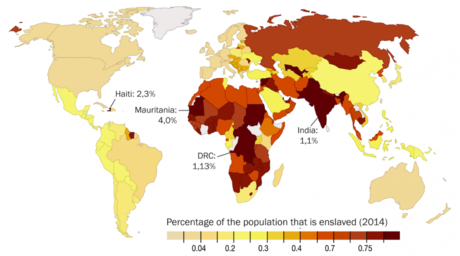
Percentage of the population that is enslaved (2014) | Source: Rick Noack in The Washington Post 18-11-2013. Data source: Walk Free Global Slavery Index.

Economic developments

The fundamental work by Bas van Leeuwen, Jan Lucassen, Jan Luiten van Zanden, Peer Vries and Joost Jonker on the processes accompanying economic change such as the spread of market institutions, wage labour and commercialization (taking deep monetization as a global indicator of these developments), and on key indicators of wellbeing at a global scale,  offers new standards, time series and typologies which are crucial for global comparisons.

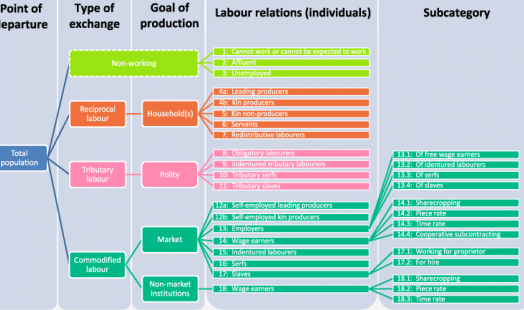
For labour relations, the Global Collaboratory on the History of Labour Relations offers data, typologies and a taxonomy of labour relations, to enable global comparisons.

Finally, Pepijn Brandon examines the long-term impact of war on economies, financial systems, states and (forced) labor.

Key publications:

  • Spek, R.J. van der, and B. van Leeuwen (eds.), Money, currency and crisis: In search of trust, 2000 BC to AD 2000 (Oxon, Routledge, 2018).
  • Pepijn Brandon, Marjolein C. 't Hart and Rafael Torres Sánchez (eds), ‘The Economic Impact of Eighteenth-Century Warfare and State Financing’, special issue Financial History Review, Vol. 25, No. 1 (2018).
  • Zanden, J.L. van, et al., How was life? Global well-being since 1820 (Paris and Amsterdam, 2015).
  • Spek, R.J. van der, B. van Leeuwen & J.L. van Zanden (eds.), A history of market performance. From Ancient Babylonia to the Modern World (Oxon, Routledge, 2014).
  • Lucassen, J. (2018). ‘Labour and deep monetization in Eurasia, 1000 to 1900’, in: Karin Hofmeester and Pim de Zwart (eds.), Colonialism, institutional change, and shifts in global labour relations. (Amsterdam, Amsterdam University Press) 327-360.

Key project

The Historical Dynamics of Industrialization in North-Western Europe and China, 1800-2010

  • Project lead: Bas van Leeuwen
  • Project start: 2015
  • Grant: circa € 1,400,000 by European Research Council | ERC Starting Grant
Historical Dynamics

Key project

Naval shipyards: Laboratories of capitalism

Naval Shipyards in the Atlantic World as Centers of Innovation in Production, Administration and Labor Control (1720-1870)

  • Project lead: Pepijn Brandon
  • Project start: 2016
  • Grant: circa € 250,000 (€ 125,000 IISH) by NWO [VENI]
  • Partners: Free University Amsterdam
Laboratories of Capitalism

Dataset

CLIO-INFRA

Clio Infra has set up a number of interconnected databases containing worldwide data on social, economic, and institutional indicators for the past five centuries, with special attention to the past 200 years. These indicators allow research into long-term development of worldwide economic growth and inequality.

CLIO-INFRA
CLIO INFRA logo

Dataset

Labour Relations

The Global Collaboratory on the History of Labour Relations is a collaborative effort to study labour relations in a global perspective. The project has two main goals. First, to provide statistical insights into the global distribution of all types of labour relations (systematically including women's and child labour) in five historical cross-sections: 1500, 1650, 1800, 1900, [Africa: 1950], and 2000. Second, to explain the signalled shifts in labour relations worldwide. 

Labour Relations
Een infographic getiteld "Taxonomie van Arbeidsverhoudingen" van de Global Collaboratory on the History of Labour Relations. Het toont een hiërarchisch classificatiesysteem voor verschillende vormen van arbeid, vertakkend van "Uitgangspunt" (Totale bevolking) naar "Type uitwisseling", "Doel van productie", "Arbeidsverhoudingen (individuen)", en ten slotte specifieke "Subcategorieën". Belangrijke categorieën van arbeid zijn onder meer niet-werkend, wederkerig, tribuut en verhandeld, elk met verdere specifiek

 Theme: Commodity frontiers and commodity chains

Ulbe Bosma has been on the forefront of the international network “Commodity Frontiers Initiative”. This collaborative (including Sven Beckert from Harvard and Eric Vanhaute from Ghent) is developing a new analytical framework with (forced) labour as a prism through which a new understanding will be obtained about the global nexus between commodity extraction, labour and environmental degradation. Furthermore, this research initiative includes the counter narratives of national and transnational social movements aiming at the empowerment of rural workers in their struggle against social and ecological injustice.

The second commodity-project is ‘Luxury and Labour’ by Karin Hofmeester which analyzes the effects of the globalization of a durable luxury commodity on labour relations worldwide. Central question of this research project will be how the globalization of the diamond trade and finishing industry - spurred by increasing consumer demand - affected labour relations in this sector worldwide. Thereby we will look at all segments of the production process 'from the mine to the finger'

Key publications:

  • Bosma, U., The sugar plantation in India and Indonesiah. Industrial Production 1770-2010 (Cambridge University Press 2013; 2017).
  • Bosma, U. , 'The Global Detour of Cane Sugar: From Plantation Island to Sugarlandia,' in Karin Hofmeester and Pim de Zwart, Colonialism, Institutional Change, and Shifts in Global Labour Relations (Amsterdam: Amsterdam University Press, 2018),
  • Bosma, U. Revisiting the Periphery: How Island Southeast Asia Became a Mass Exporter of Labor. Under contract and under review with Columbia University Press.
  • Hofmeester, K., ‘Economic institutions and shifting labour relations in the Indian, Brazilian, and South African diamond mines’, in: K. Hofmeester and P. de Zwart (eds.), Colonialism, institutional change, and shifts in global labour relations. (Amsterdam, Amsterdam University Press) 67-107.
  • Hofmeester, K. and B. Grewe (eds), Luxury in Global Perspective: Objects and Practices, 1600 - 2000 (Cambridge: Cambridge University Press, 2016)
  • Hofmeester K., 'Shifting trajectories of diamond processing: from India to Europe and back, from the fifteenth century to the twentieth',  Journal of Global History, volume 8, no 1 (2013), pp 25-49

Key Project

Commodity Frontiers: Capitalist Transformations of the Global Countryside During the Past Six Centuries

This large multi-year project aims to study the long history of commodity frontiers through an interdisciplinary research design that uses both written archival sources and fieldwork.

Commodity frontiers
Commodities in the Harbour | source: wikimedia.org

Key Project

Luxury and Labour, a global trajectory of diamond consumption and production, 16th -19th century

In the past four hundred years large scale circulations of people, ideas and commodities took place, leading - amongst other things - to shifts in labour relations worldwide. Many historians share the idea that consumption plays an important role in the production of these commodities and therefore also in shaping labour relations.

Luxury and Labour

Theme: The spread of forced labour and slavery

Global comparisons of unfree (slave) labour has expanded considerably with the research projects of Matthias van Rossum, Ulbe Bosma, Marcel van der Linden and Pepijn Brandon. Especially Van Rossum’s work on forced labour in Asia in the early modern period, showing a much greater spread and variance of slave labour than commonly assumed, and their function for economic developments, has led to a new paradigm that decenters the Atlantic slavery historiography and highlights transcontinental connections in the nexus of labour, trade and commodities.

Key publications, projects and datasets

Key publications:

  • Rossum, M. van & K. Fatah-Black, ‘Beyond profitability. The Dutch Transatlantic slave trade and its economic impact’, Slavery and Abolition 36 (2015) 1, 63-83.
  • Rossum, M. van & J. Kamp, Desertion in the Early Modern World: A Comparative History (Bloomsbury: London 2016).
  • Linden, M. van der & M. Rodríguez Garciá (eds.), On Coerced Labor Work and Compulsion after Chattel Slavery (Leiden and Boston, Brill, 2016).

Key projects:

Theme: Precarization

Marcel van der Linden has kept on pushing the theoretical frontier of global labour history, e.g. by rethinking the contribution of Marxian ideas for future developments of capitalism, precarity and labour relations and collective reactions against this development.

Matthias van Rossum and his team have developed this theme in a joint project with the Dutch Trade Union Federation (FNV) and published an agenda-setting report on the future of unions in an era of flexibilization.

Key publications, projects and datasets

Key publications:

  • Linden, M. van der & K. H. Roth (eds.), Beyond Marx. Theorising the Global Labour Relations of the Twenty-First Century (Leiden and Boston, Brill, 2013).
  • Breman, J. & M. van der Linden, Breman, ‘Informalizing the economy: the return of the social question at a global level’, Development and Change 45 (5): 920-940.
  • Moira van Dijk, Matthias van Rossum, Loran van Diepen, Rosa Kösters en Bob Scholte, Precaire polder ((Amsterdam 2018).

Key project:

Finished projects