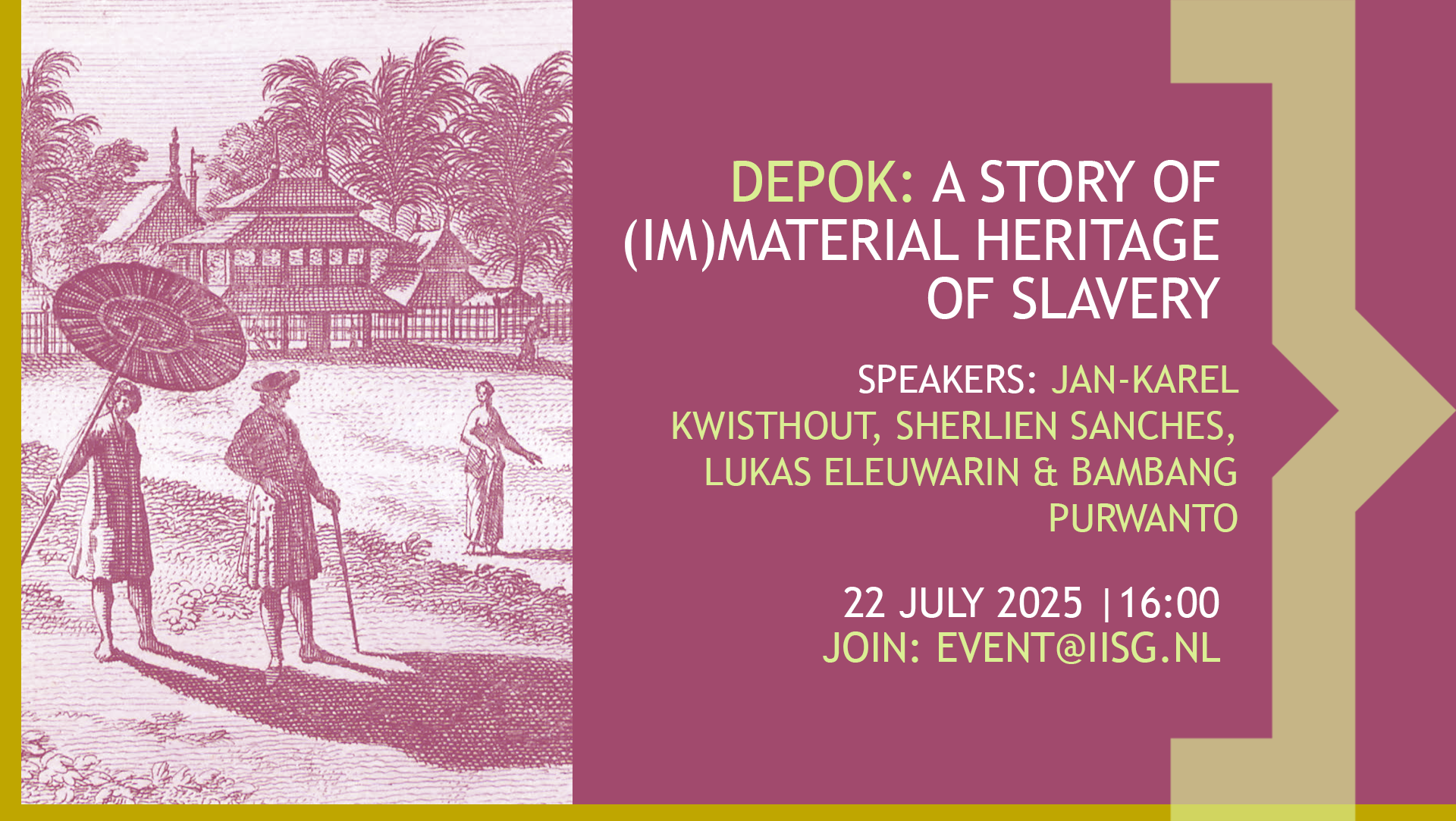
Depok: A Story of (Im)material Heritage of Slavery
The International Institute of Social History (IISH) invites you to join this seminar about the history of Depok and its (im)material heritage of slavery. This seminar will take place on 22 July 2025 at 16:00h in the Posthumus Room.
When VOC merchant Cornelis Chastelein bought a pepper plantation outside of Batavia (Jakarta) called Depok, he purchased twelve enslaved families from various parts of the archipelago like Bali, Ambon, and Sulawesi. In his will, Chastelein manumitted the 200 enslaved individuals working on his lands and stipulated, upon his death in 1714, that they would become collective owners of the Depok estate. This estate, not far from Jakarta, became an autonomous region governed by freed slaves and their offspring. The story of Depok is an exceptional one, and it reveals the deep complexities of colonial relationships where acts of manumission could coexist with systems of exploitation. It invites us to reflect on the lasting ramifications of slavery, including contested notions of freedom, identity, and land ownership that continue to shape postcolonial societies today.
During this afternoon, Jan-Karel Kwisthout will discuss the history of Depok in the 17th and 18th centuries, the role of Chastelein and the VOC. Afterwards, Sherlien Sanches and Lukas Eleuwarin (Kenniscentrum Immaterieel Erfgoed Nederland, or KIEN) attend to the role of intangible heritage in current-day Depok and share their methodologies of working with this heritage. And lastly, Prof. Dr. Bambang Purwanto (Universitas Gadjah Mada, Indonesia) will offer his reflections on the history of Depok and the day’s presentations. Afterwards, there will be room for questions and drinks.
This event is organized by Britt van Duijvenvoorde and Pascal Konings (IISH). If you wish to join the event, please register by sending an email to event@iisg.nl.
Practical
Date: 22 July 2025
Time: 16:00h
Place: IISG, Cruquiusweg 31, Amsterdam
Entrance: Free admission, but please send an email to event@iisg.nl if you want to join. It is also possible to join online! Please let us know if you want to receive the link to the Zoom meeting.
Jan-Karel Kwisthout
Jan-Karel Kwisthout is a lawyer by profession. He studied State and Administrative Law as well as Environmental Law at Leiden University in the Netherlands. He currently works at the Dutch Ministry of Infrastructure and Water Management and has a vast experience in European and national policy making and international environmental treaty negotiations. His personal interest in Depok was aroused during his studies at Leiden University. His Depok family belongs to one of the twelve families that are considered to be descendants of the freed Christian slaves of Cornelis Chastelein. The history of Depok was originally an oral history, passed on from generation to generation. After thorough historical research, Jan-Karel Kwisthout verified and documented that history and he published on various aspects of Depok and the significance of Cornelis Chastelein for the Depok community. In February 2024, his latest book Drie Eeuwen Depok (“Three Centuries of Depok”) was published, containing a comprehensive history of the town and its inhabitants.
Sherlien Sanches
Sherlien Sanches works at the Kennisinstituut Immaterieel Erfgoed Nederland (KIEN) as an advisor on international heritage cooperation. In this role, she builds bridges between heritage communities in Suriname, Indonesia, India and the Netherlands. She supports cultural exchanges and is committed to making unidentified intangible heritage visible, with a particular focus on stories that have been neglected until now. She is committed to mutual exchange, recognition and visibility of intangible heritage, particularly of communities that are still underrepresented in heritage practices and policy.
Lukas Eleuwarin
As a community advisor on international heritage cooperation, Lukas Eleuwarin is committed to helping communities with roots in Indonesia, Suriname and India. Lukas works as a bridge builder, cultural ambassador and motivator at the intersection of heritage and society. His strength lies in supporting communities in making their intangible heritage visible and passing it on. This revolves around ownership, trust and strengthening connections within the community and with heritage institutions. Thanks to his many years of experience and extensive network, he has great expertise in connecting people, stories and traditions. In doing so, he always considers the broader context in which heritage exists, such as migration, colonial history and identity.
Bambang Purwanto
Bambang Purwanto is a professor at the Department of History, Faculty of Cultural Sciences, Gadjah Mada University. Prof. Purwanto completed his undergraduate studies at the Department of History, Gadjah Mada University in 1984 with a thesis titled ‘The Roem-van Roijen Statement: A Dilemma Beneficial to the Republic of Indonesia.’ He continued his master's studies with a focus on the history of Southeast Asia at the University of London. He completed this programme in 1989. Shortly after graduating, Dr. Bambang pursued his doctoral studies at the same institution, the School of Oriental and African Studies, University of London, with a dissertation titled ‘From Village to Market: Native Rubber Cultivation in Southern Sumatra, 1890–1940.’