Presentations Global Slavery History Fellows
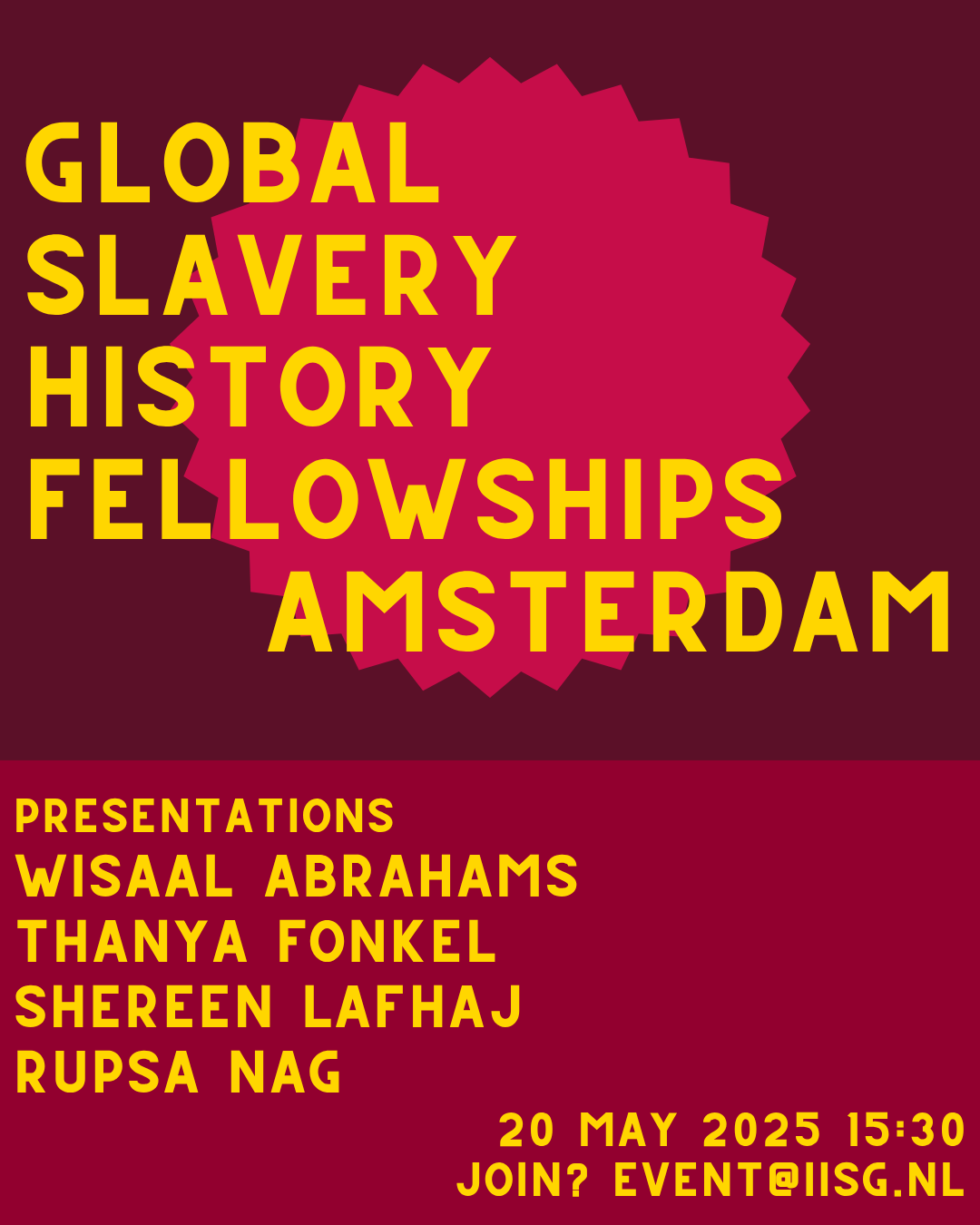
A coalition of Amsterdam based Archives, Museums and Historical institutes has taken the initiative for fellowships for curators, archivists and historians in the field of slavery history. The second group of fellows of the Global Slavery History Fellowships - Wisaal Abrahams, Thanya Fonkel, Shereen Lafhaj and Rupsa Nag - will present the results of their research on 20 May at the IISH.
Wisaal Abrahams: "The Technology of Ceremony". Applied Research Methodologies where East meets West.
Wisaal Abrahams' presentation will address the archival void in relation to the Cape Malay Nederlands Liedtjies and the general education around the Cape Malay People of South Africa. Examples of Abrahams' current community project with the Cape Malay Choir Board will be used to frame the case for filling this void and what the role of northern researchers and archivists can be to assist matters in affected communities on the ground.
Thanya Fonkel: Warriors kept apart. Independent, but separated Maroon communities.
Two of the six Surinamese Maroon communities, the Saamaka and the Matawai, were treated as one group by the colonial government when they signed a peace treaty in 1762. Almost immediately, conflicts arose and the Saamaka and Matawai split and went their own ways. Their leaders were warriors who fought the Dutch colonial government in the 17th and 18th centuries.
Colonial powers encouraged discord and created misconceptions between these maroon fighters. Nowadays their descendants are making difficult attempts to work together but we see that events from the slavery past continue to influence the relationship.
In archives from the 17th to the 19th centuries, Thanya Fonkel examines how people dealt with the phenomenon of marronage and provides insight into the events and decisions that kept maroons in a disadvantaged position. Attention is also paid to the perspective of Black consciousness and its development.
Shereen Lafhaj: Curating Indian Indenture.
In this presentation Shereen Lafhaj reflects on connections between the Dutch and British Indian indenture systems and how we can effectively present Indian indenture histories in museum settings. Areas examined include how various institutions have approached the subject and the often ignored emotional experience of working on Indian indenture related projects.
Rupsa Nag: Entanglement of textile trade and slavery in the context of Dutch colonialism across the Indian Ocean coastlines.
Rupsa Nag will address her findings, in the course of the fellowship, about the entanglement of textile trade and slavery in the context of Dutch colonialism across the Indian Ocean coastlines. With Indian textile comprising 84% of the VOC's cargo, this research highlights the need to rethink narratives around fashion, colonialism, caste and slavery and illuminates neglected histories of Dutch colonialism in South Asia. Reading textile artefacts from the Rijksmuseum in juxtaposition with VOC archives across Indian Ocean coastlines, Nag centers the materiality of cloth and the ''body turned flesh'' in the words of Hortense Spillers, she highlights the heft of de/colonisation that is often emptied out in institutional contexts trying to navigate it largely through representational strategies of inclusion. The focus on materiality allows for and encourages embodied critical mediation on art and aesthetics to address colonial imperial histories of rape, pillage and genocides that created the current global racial capitalist economy sustained in South Asia by other forms of local hierarchies like caste patriarchy, that cultural institutions like museums are also complicit in. These findings will eventually be worked into a creative audiovisual piece that seeks to provoke critical reflection on the complex history of textiles and Europe that cannot be held in depoliticised terms like global influence.
Practical
Date 20 May 2025
Time 15:30
Place IISG, Cruquiusweg 31, Amsterdam
Entrance Free entrance, but please register at event@iisg.nl (zoom link upon request)
Wisaal Abrahams is a coach and visual artist who specialises in the intersectionality - how spirit meets cause in a post-colonial reality. Her latest piece of work adopted from her coaching curriculum called “The School of Pressure” is currently being developed as a virtual reality application and a textbook in the form of a startup and a research thesis by educational expert Scott Unwin. Her work has also been included in various academic colloquiums hosted by scholars from Kings College London, Royal Central School of Speech and Drama and participated in numerous seminars on Gender and Islam at UCT. She began her career early and was selected to attend the UN Sustainable Development Goals Conference as a South African Youth Representative in 2010. From 2011 – 2013 she resided in Gothenburg Sweden where she worked in early child development, theatre and film. In 2015 she addressed the EU Permanent Mission in Brussels as part of a peace delegation led by Global NGOS regarding Islamophobia and Extremism. Her work in her own community, the Cape Malay Community, has been to showcase the Nierderlands Liedjies to the larger cultural fabric of our beautiful port city in Cape Town. In 2018 she co-produced a documentary called The Art of Fallism with a team from Norway, about the infamous FeesMustFall movement, focusing on the lens of young local artists who were creating works based on those challenging events; the film travelled to various international film festivals including HotDocs, Cinema Du Reel and Durban International Film Festival. Her latest collaborative art piece (Nardstar/Faheem Rhoda Jackson/ was commissioned by Afrikaans100, the recently contested language centennial and is a public mural located in the national heritage area of the Bokaap in Cape Town called “Afrikaans: The Origin”. She is currently completing an MA in Visual Art at Stellenbosch University and is a Global Fellow at IISG on Slavery.
Thanya Fonkel is from Suriname and she is an independent researcher paying special attention to oral sources within Maroon communities. Her main research focus is socio-cultural topics concerning the development of Maroons. She is also active as a community development worker in Maroon and Indigenous communities. She studied History at the Anton de Kom University of Suriname, Faculty of Humanities. She also completed the Master of Public Administration in Governance (MPA) programme at the FHR Lim A Po Institute for Social Studies (FHR), in collaboration with The Erasmus International Institute of Social Studies (ISS).
Shereen Lafhaj is a curator, writer and overall passionate storyteller from London. Her work centres underrepresented histories with care and creativity. She currently works at London Museum.
Rupsa Nag is a researcher and cultural worker and graduated in RMA Gender Studies from the Utrecht University and the University of York. As a multidisciplinary researcher, Rupsa is interested in questions of home, nationhood, memory, trauma, history, sexuality and the politics of visibility and adopts embodied, anticolonial, critical caste and materialist analytical approaches.