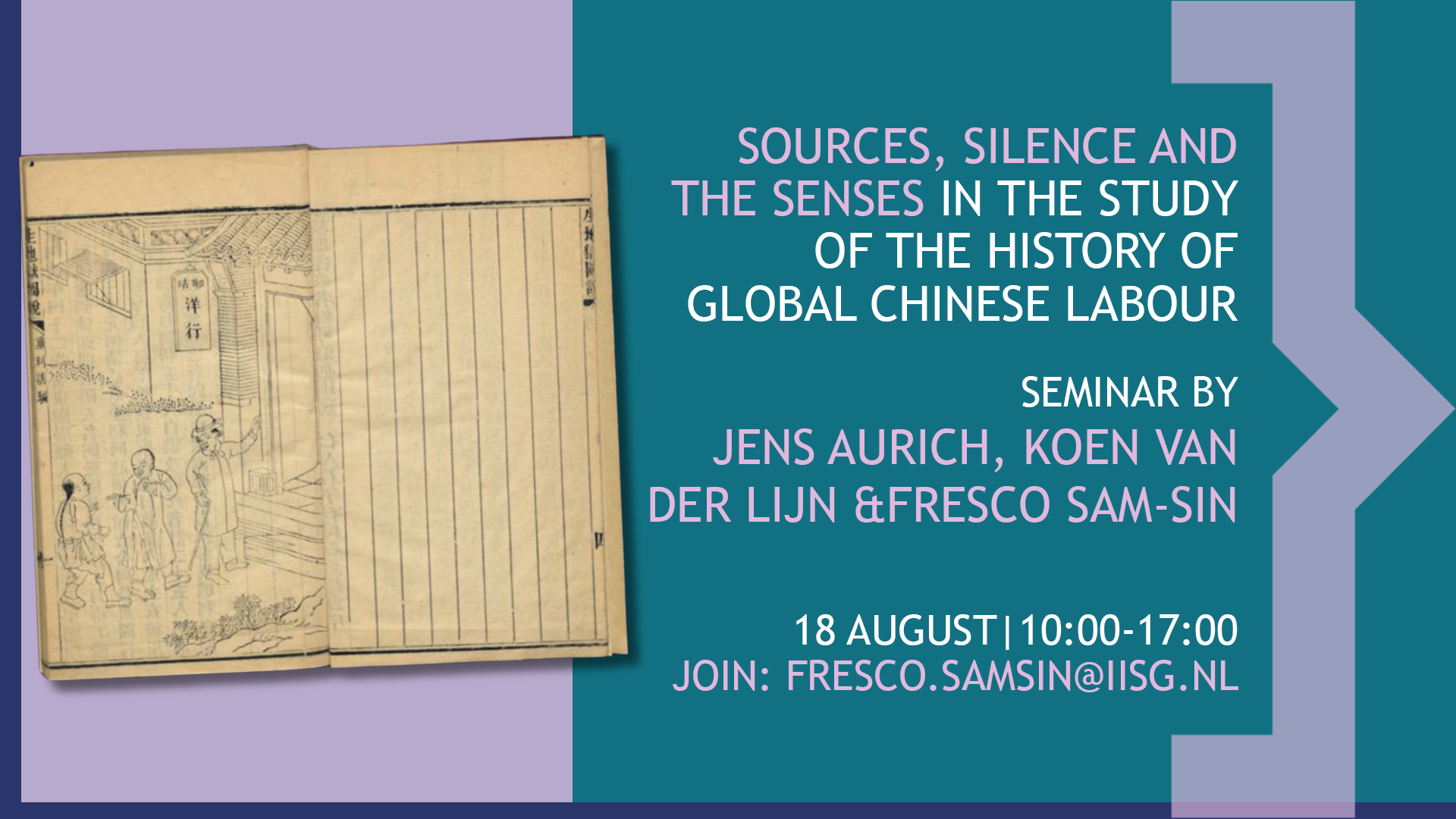
Sources, silence and the senses in the study of the history of global Chinese Labour
The IISH invites you to join this seminar about research methodes regarding the history of global Chinese labour. The keynote speaker is Evelyn Hu-DeHart, Professor of History and American Studies at Brown University.
A critical engagement with archival material is fundamental to understanding the history of labour in colonial contexts. Central to this inquiry are our reading strategies—both against and along the grain of the archives—which serve as essential tools in navigating and interrogating these sources. In this seminar, we aim not only to contextualize such strategies within the framework of global Chinese labour history—particularly by considering issues such as multilingualism, intermediaries and transcultural dynamics—but also to examine the potential contributions of non-archival sources. Special attention will be given to material culture, silence, and the senses. We ask: What insights can objects provide that elude the written archive? When does silence speak more profoundly than text? And what unique dimensions does sensorial information offer in historical analysis?
Keynote speaker and listener
For this seminar, we are pleased to welcome Professor Evelyn Hu-DeHart, Professor of History and American Studies at Brown University. Professor Hu-DeHart will deliver the keynote presentation lecture, Degrees of Freedom and Unfreedom: Chinese Contract Laborers ("Coolies") in Cuba in the Nineteenth Century . At the end of the afternoon, she will share her refl ections and observations, helping us identify the common threads that connect our research.
Presenters
Each participant will present three case studies. Goal is to foster collective reflection and opportunities to advance one another’s research. In max. 20 minutes each participant is asked to:
- Introduce their research, including their motivation for participating in the seminar (ca. 5 minutes)
- This is followed by one case study highlighting a moment in your research that involved a tension between reading with and against the archival grain.
- In closing each participant will present two case studies illustrating how material culture, silence, or sensory data complicated, nuanced, or contradicted archival information.
Programme
10:30 - 10:45 Opening
10:45 - 11:15 Dr. Anne Haeming Bonn Center for Dependency and Slavery Studies
This presentation is meant to sharpen our focus. Dr. Haeming will talk about practical approaches to confront the bias of data, historical records and the subjectivity of knowledge production and the challenges involved.
11:15 - 11:30 Discussion
11:30 - 11:45 Short break
11:45 - 13:00 Things That Talk
Together, we will explore a series of artefacts in the room. Guided by Fresco Sam-Sin and Koen van der Lijn, we will trace connections between these objects and the global history of Chinese indentured labour, inviting you to refl ect on your own sources and research.
13:00 - 14:00 Lunch at IISG
14:00 - 14:30 Evelyn Hu-DeHart Brown University
Keynote | Degrees of Freedom and Unfreedom: Chinese Contract Laborers ("Coolies") in Cuba in the Nineteenth Century
In 1846, the Spanish colony of Cuba in the Caribbean received the first of many shipments of human cargo in Havana, totaling 125,000 men in 25 years. Under 8-year contracts, they were predominantly bound for the sugar plantations to supplement a dwindling supply of enslaved Africans. While smaller contingents of Chinese coolies were shipped to the British, French and Dutch West Indies (empires which had abolished African slavery and also recruited coolies from British India), and to the new republic of Peru in South America, it was only in Cuba where Chinese men labored alongside enslaved African men and women. This historical laboratory of two dependent and racially distinct groups of plantation workers living and working side by side for half a century presents a unique opportunity to ask critical questions about freedom and unfreedom: were the Chinese coolies slaves just like the Africans, or were they hombres libres/ free men? I will examine this question on the basis of three important documents: 1) the bilingual Spanish-Chinese contracts executed before embarkation; 2) the recontracts executed in Cuba and their aftermath; and 3) the Imperial Chinese Cuban Commission report of 1873, which took oral and written testimonies from almost 2,000 coolies on several plantations.
14:30 - 14:45 Discussion
14:45 - 14:50 Short break 20-minute-presentations, each followed by 20-minutes of discussion
14:50 - 15:30 Dr. Bastiaan Nugteren link Rijksuniversiteit Groningen
15:35 - 16:15 Dr. Viola Muller link Wageningen University & Research
16:20 - 17:00 Koen van der Lijn link Rijksmuseum Amsterdam
17:00 - 17:20 Closing | Prof. Dr. Evelyn Hu-DeHart link Brown University A refl ection on the day. Identifying the common threads that connect our research, exploring opportunities for collaboration
Procedure
This event is open to the public, and we warmly invite you to engage with our presenters. Kindly register by August 11 by sending an email to fresco.samsin@iisg.nl , including a brief description of your interest or connection to the topic. Lunch will be provided.
This seminar is organised by Jens Aurich (IISG), Koen van der Lijn (Rijksmuseum Amsterdam) and Fresco Sam-Sin (Things That Talk), connected to the Contract Labourers and Collective Action project at IISG.
Evelyn Hu-DeHart wrote a book that's dedicated to this topic called "Degrees of Freedom and Unfreedom: Chinese Contract Laborers ("Coolies") in Cuba in the Nineteenth Century. "
Abstract:
In 1846, the Spanish colony of Cuba in the Caribbean received the first of many shipments of human cargo in Havana, totaling 125,000 men in 25 years. Under 8-year contracts, they were predominantly bound for the sugar plantations to supplement a dwindling supply of enslaved Africans. While smaller contingents of Chinese coolies were shipped to the British, French and Dutch West Indies (empires which had abolished African slavery and also recruited coolies from British India), and to the new republic of Peru in South America, it was only in Cuba where Chinese men labored alongside enslaved African men and women. This historical laboratory of two dependent and racially distinct groups of plantation workers living and working side by side for half a century presents a unique opportunity to ask critical questions about freedom and unfreedom: were the Chinese coolies slaves just like the Africans, or were they hombres libres/free men? I will examine this question on the basis of three important documents: 1) the bilingual Spanish-Chinese contracts executed before embarkation; 2) the recontracts executed in Cuba and their aftermath; and 3) the Imperial Chinese Cuban Commission report of 1873, which took oral and written testimonies from almost 2,000 coolies on several plantations.