30 May 1969: Revolt on Curaçao
The French student protests of May 1968 are well known and have been widely commemorated. But how many people know the story of 30 May 1969 in Curaçao?
On Treinta di Mei, striking Shell workers marched through Willemstad. Riots broke out, accompanied by vandalism and looting. The police intervened with increasing violence, but the resistance only grew stronger. By the end of the day, two strikers had been shot dead, dozens had been injured and parts of the city centre had been destroyed by fire. A curfew was imposed and enforced by Dutch marines, and 322 demonstrators were arrested. However, the long-standing discontent over colonial rule, economic exploitation, and racist oppression — particularly against black Curaçaoans — has come to the surface, and the balance of power on the island has changed forever.
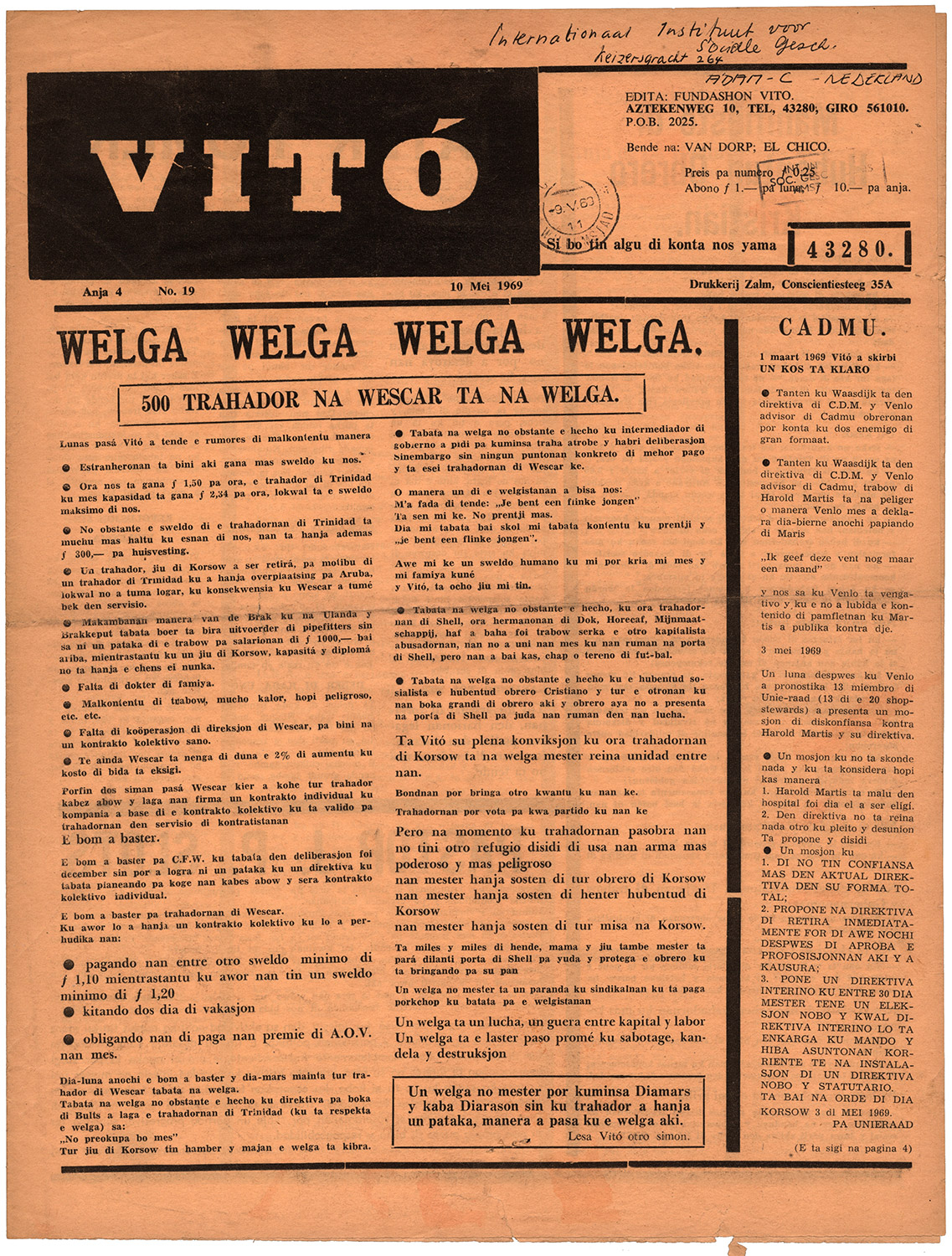
The immediate cause of the strike was that: Antillean workers at the Shell refinery, the island’s largest employer, were earning less than their Dutch counterparts for doing the same job. Furthermore, workers employed by Shell via a subcontractor were earning roughly half as much as those employed directly by Shell, which was the company's reason for increasingly relying on subcontractors. This was good for Shell and the subcontractors, but not for the Antillean black workers, who were already suffering most from the deteriorating economy. The fact that it had now come to such an outburst was not without precedent. Social, political and racial tensions had been mounting for years, and self-awareness had grown among black Curaçaoans. Inspired by anti-colonial and revolutionary liberation movements, Black Power and the Black Panthers, they too were looking beyond their borders. The weekly magazine Vitó played a major role in this awakening.
Vitó began publication in 1965. Its editor-in-chief, Stanley Brown, who wrote many of the articles, drew inspiration from the Dutch Provo movement in the early days. The magazine had a playful and creative aesthetic, featuring many illustrations. Vító rebelled against Dutch rule, social inequality, and discrimination. The articles were mainly in Dutch. From 1967 onwards, however, it was primarily published in Papiamentu, the language of the black majority. This was significant because Papiamentu was not used in schools and was not even permitted to be spoken in the Antillean parliament. This gave Vitó a much wider reach. Gradually, the magazine also became more political and outspoken. The Vitó group organised numerous campaigns. Brown and the magazine were in contact with other black groups and activists, including the radical trade union leaders Wilson 'Papa' Godett and Amador Nita, who were very influential. When the trade unions took action and went on strike in May, Vitó served as their mouthpiece.
After Trinta di Mei, events unfolded rapidly. The trade unions demanded the resignation of the entirely white government, which happened within a few days. While Godett was in hospital after being shot in the back by the police on 30 May and Brown was in prison after being sentenced to four months for incitement, Nita established a political party with them called the Frente Obrero i Liberashon 30 di Mei (FOL). In the September elections, the party won three of the 21 seats in the Curaçao parliament. The trade unions gained more members and influence. Papiamentu is increasingly recognised as the island’s true language. Dutch politicians begin to realise that the 'overseas territories' must be granted greater self-government or full independence. In 1970, Curaçao elected its first black governor, who was born on the island.
Vitó continues to be published weekly. It is no longer an underground magazine that can protest against all kinds of abuses from a position of freedom. However, the collaboration between Brown and Godett becomes strained due to personal and political differences. The final issue was published in June 1971.
The six volumes of Vitó offer a unique insight into the rapid development of the emancipation process on Curaçao. Political, economic, cultural and racial aspects were intertwined. Although there were international sources of inspiration, the movement focused on its own situation and population. This culminated in a radical shift in power on Curaçao on 30 May, with long-lasting consequences for the Netherlands as well as Curaçao.