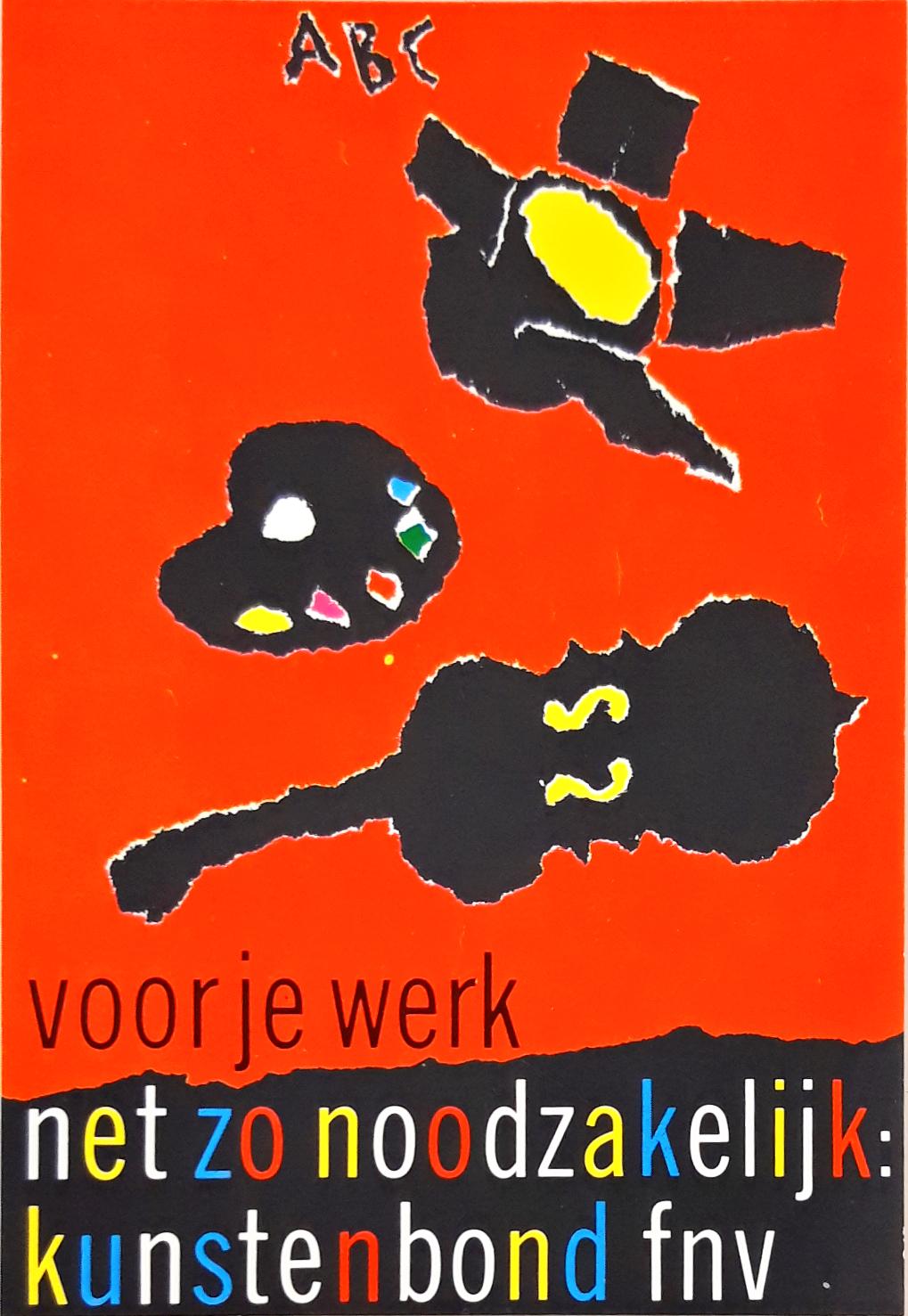
Kunstenbond FNV
As part of the FNV archive project, another archive has been processed. The archive of the Kunstenaarsorganisatie-NVV, later known as the Kunstenbond FNV, has now been organised and catalogued.
Like any union, the Kunstenbond champions the interests of its members; in this case, a very diverse group. They are referred to as ‘The clowns of the FNV’ in a discussion paper on the position of the arts within the trade union. From opera singers to pop musicians, from voice actors to mime artists, from members in permanent employment such as film laboratory staff and music teachers, to freelancers in the independent sector such as sculptors, filmmakers, translators, jazz musicians and acrobats: it is clear that the interests vary from one professional group to another. However, all members share the common ground that there is much room for improvement in their legal status and terms of employment. Without the support of government subsidies and often without the protection of a collective labour agreement, members face an uncertain future.
The Kunstenbond campaigned to improve the position of artists, expressed solidarity with oppressed filmmakers and artists in Latin America, protested against apartheid, organised nationwide campaigns for a better subsidy policy and against cuts in the arts, and sought contact with arts institutions, policymakers, politicians and international organisations.
What might you find in the Kunstenbond’s archives? The vicissitudes surrounding the survival of the touring opera and operetta company Opera Forum, for example, which are documented in detail. Furthermore, labour law cases concerning Pipo the clown, the fee arrangement for a TV appearance, or a thank-you note from the one and only Sinterklaas (Bram van der Vlugt, of course). But also the attempts by orchestra and choir members to resist dictatorial conductors, a member survey entitled “The Kunstenbond? Don’t even get me started!”, and documents about the meetings of the members of the Mime section, who are more outspoken than you might expect from such a silent profession. In addition, there are examples of the practical assistance the Kunstenbond offers its members, such as supporting music teachers in drafting statutes or internal regulations for their music schools, efforts to curb the long and irregular working hours of theatre technicians, or the creation of the handbook ‘ Pop and the Paperwork’, which explains how the unsuspecting novice pop musician should manage their paperwork and find their way around the world of standard contracts, bookkeeping and legal structures.
Alongside meeting minutes and policy papers, one sometimes finds the heartfelt cry of a union member: ‘Socialism in general, and the trade unions in particular, have managed to turn “the” worker into a completely materialistic, pocket-sized capitalist.’ He laments that ‘precisely that part of the trade union which, by definition, focuses on the experience of universal human and cultural values – in other words, the KONVV – shows no sign whatsoever of addressing or rectifying this very shortcoming.’ With great difficulty, one could occasionally read a short piece in the Kunstenaarskrant (!) suggesting that it is necessary and desirable to give the worker a boost through ‘culture’. But these remain merely incidental, marginal notes.’
In the archives of the Kunstenbond, a picture emerges between the lines of cultural and political/social life in the Netherlands in the 1970s and 1980s (between 1976 and 1983). The presence of numerous theatre groups and companies, radio choirs and regional orchestras, the responsibility the government felt towards the cultural sector (BKR, art libraries, the Percentage Scheme for Visual Arts) and the focus on democratisation, both in society and within the trade unions themselves.
This text and the archive inventory were compiled by Anna Smolders and can be viewed on the IISG website: https://search.iisg.amsterdam/Record/ARCH00767.