Seminar Micro-Global Histories of Slavery: Sources and Approaches
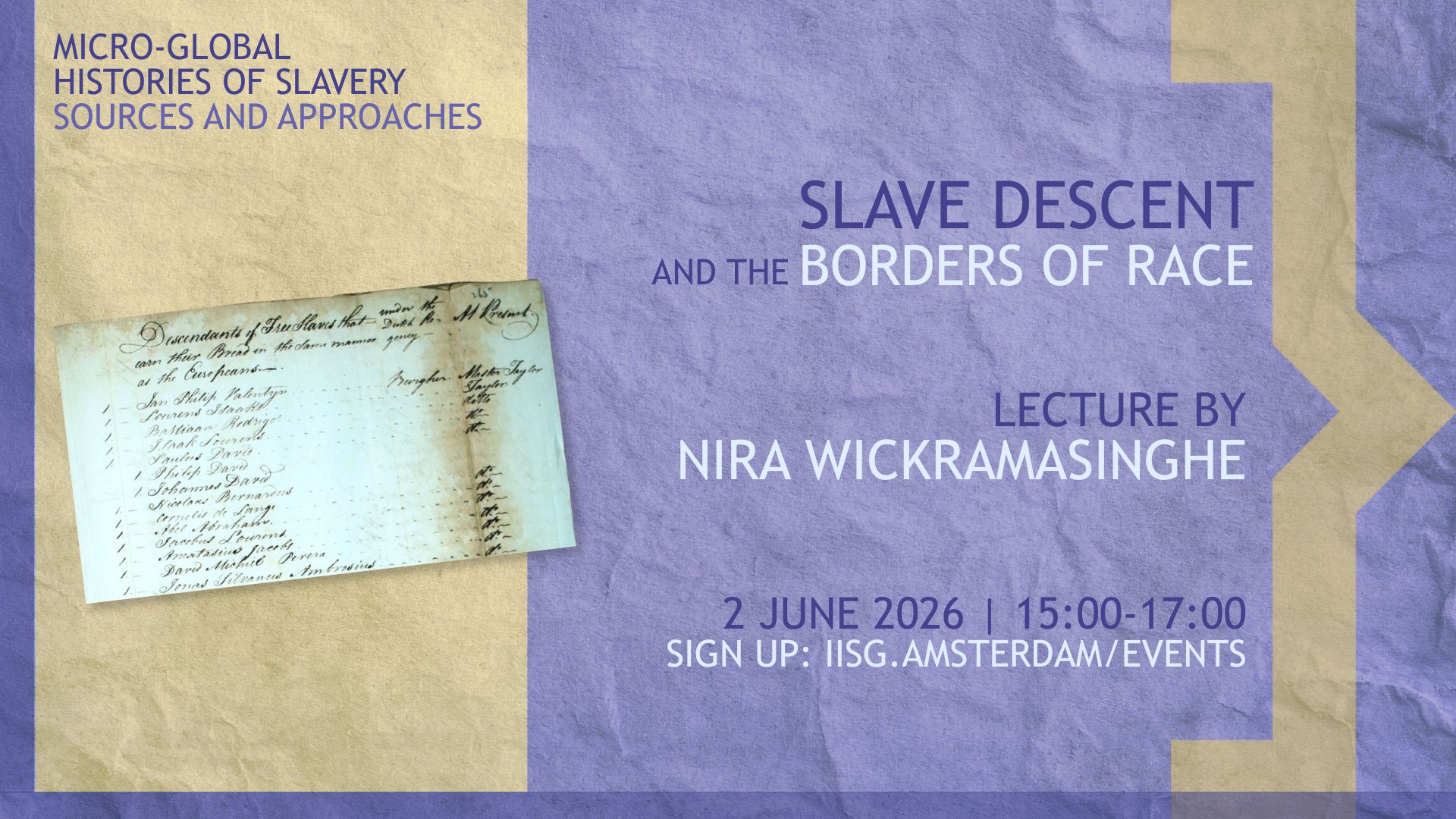
In early nineteenth century Sri Lanka, slave descent was still recorded through state institutional practices. All were disciplinary in a similar and explicit manner: court cases, police records, health/epidemic records, censuses, slave registers, thombos (land and school registers) were the privileged written loci where reference to slave descent appeared.
In a parallel fashion this period witnessed a sharpening of boundaries between communities in the island and claim-making based on notions of purity, authenticity, and middle class status. The context was one of a colonial state that was beginning to distribute entitlements to competing cultural/linguistic groups. Slave descent as an index of ‘racial impurity’ became instrumentalized by aspiring elites to evict from their community-in-making elements that were deemed unsuitable to their ambitions as a community.
Through the close reading of a constable’s list of inhabitants in the port city of Colombo, Nira Wickramasinghe will explore the idea of mixity and the formation of racial borders in the longue durée.
Practical information
Date: 2 June 2026
Time: 15:00
Venue: IISH, Cruquiusweg 31, Amsterdam
Admission: Free admission, but please register via event@iisg.nl
Language: English
Nira Wickramasinghe (Leiden University) primary interests are identity politics, everyday life under colonialism and the relationship between state and society in modern South Asia. She pursued these interests through investigation into such diverse themes as politics of dress, civil society, citizens and migrants, and objects of consumption. Her current research addresses the genre of minor histories through studies of enslaved people and migrants in the Indian Ocean world. Her most recent book is Slave in a Palanquin: Colonial Servitude and Resistance in Sri Lanka (New York: Columbia University Press 2020).