Film screening and Q&A about Spanish migration and anti-Francoist solidarity (1960-1980)
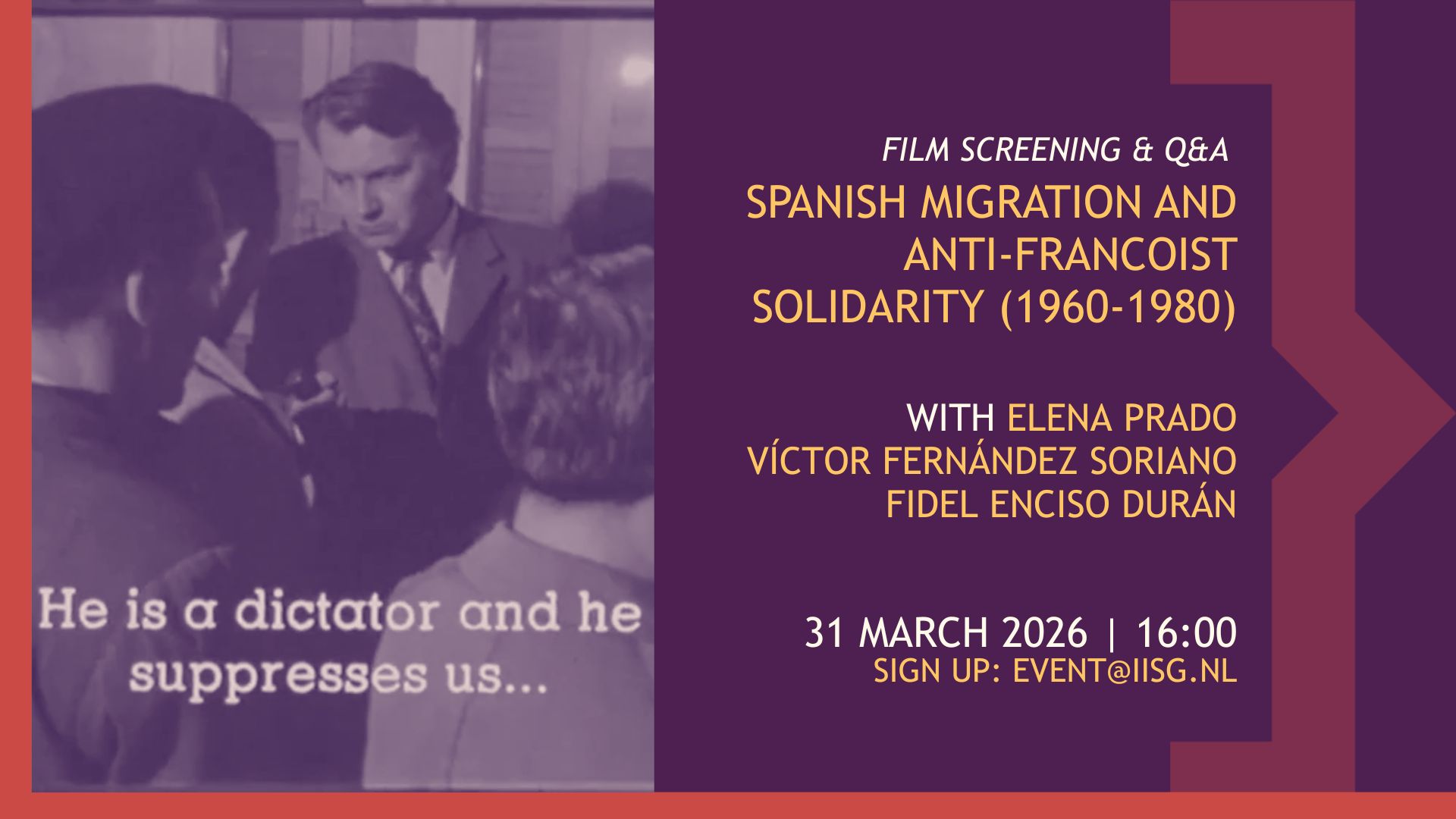
On March 31st, the IISG will present the newly found and digitized film No Passport for Spain (1969).
No Passport for Spain was produced in 1969 by the Dutch broadcaster VARA. It was part of an international campaign organized by the International Confederation of Free Trade Unions (ICFTU) to denounce the lack of union rights in Spain under Franco's regime. In the film, Dutch reporter Pier Tania crosses the Spanish border clandestinely to interview workers who have raised in strike in Spain, and who are being arrested and tortured by the Spanish police. The film was produced in collaboration with Spanish migrants and activists living in the Netherlands.
Today, the film sheds light to the role of Spanish migrants in transnational activism and to the emergence of an international anti-Francoist movement in the context of 1960s new social movements, two aspects rarely acknowledged by Spanish historians. It also raises questions about the reparation of the victims of Francoism, an issue still unresolved in contemporary Spain. The presentation, moreover, will stress the value of audiovisual collections for historical research and activism and highlight work currently done by IISG in digitizing and making accessible its film collections.
Fidel Enciso Durán, film archivist and researcher (IISG), will introduce the film as part of a broader collection of activist media and militant film preserved at IISG. Afterwards, there will be a Q&A with researcher Víctor Fernández Soriano and artist Elena Prado, both currently involved in projects related to the legacy of Spanish migration and anti-Francoist solidarity during the 1960s and 1970s.
Practical
Date: 31 March 2026
Time: 16:00 - 17:00
Place: IISG, Cruquiusweg 31, Amsterdam
Entrance: Free admission if you register to event@iisg.nl
Language: English
Víctor Fernández Soriano is a history lecturer at the Université Libre de Bruxelles, where he teaches historical criticism and global history. He studied History at Universidad Complutense de Madrid and Scuola Normale Superiore di Pisa. He earned his PhD at the ULB with a thesis dissertation on European integration and Southern dictatorships. He has published numerous articles on human rights and the end of dictatorial rule in Spain and Greece, international solidarity movements, transnational activism against torture in the Long Seventies as well as on Belgium and the Spanish Civil War.
Elena Prado studied Fine Arts at the University of Salamanca, the Gerrit Rietveld Academy in Amsterdam and the Jan van Eyck Academy in Maastricht. Elena Prado settled permanently in the Netherlands in 2003. In her work Prado focuses on investigating the changes in our social thinking within a multicultural society. Elena Prado is very interested in promoting mediation processes and working on memory through collaborations with communities.