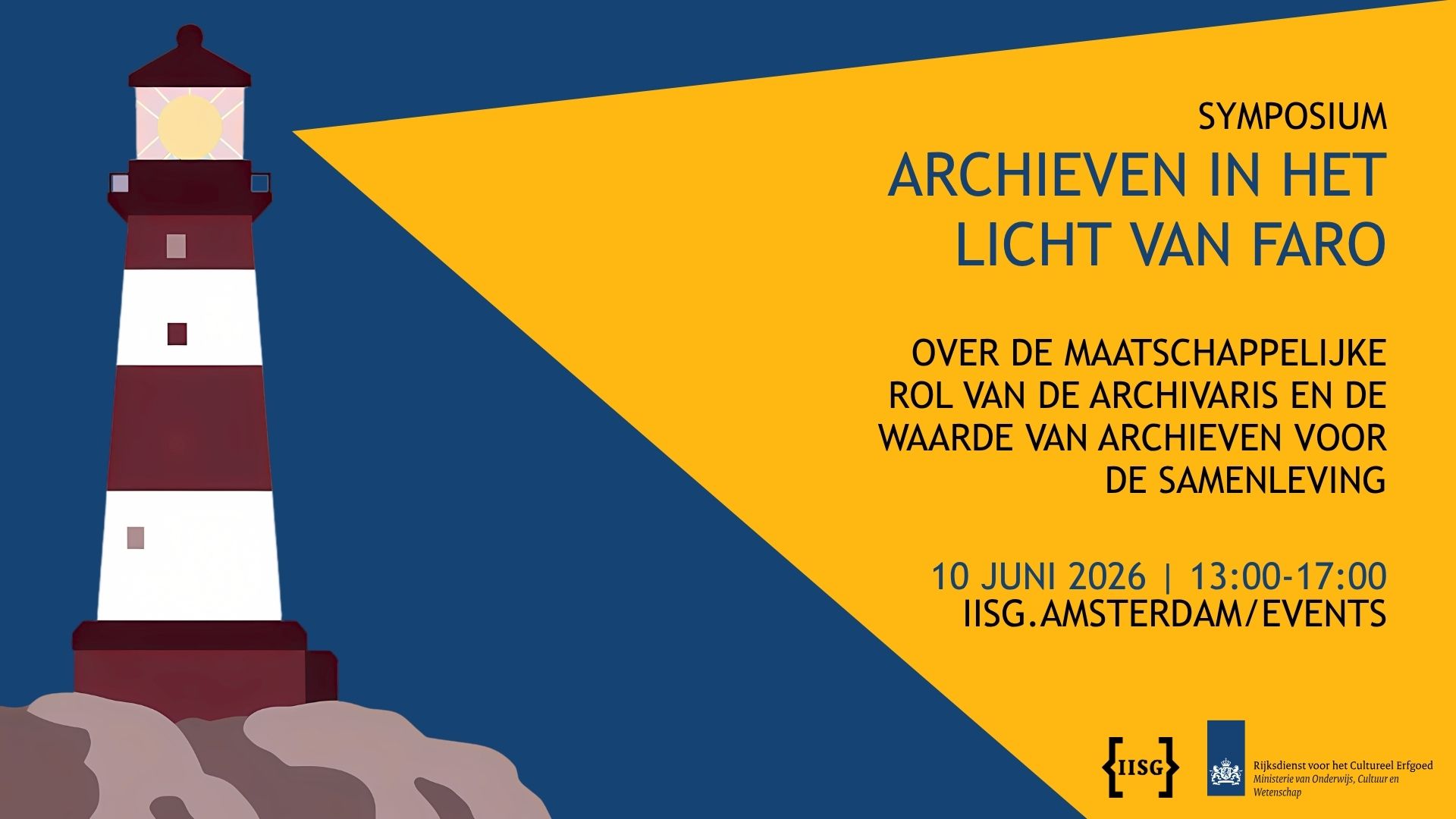
Symposium: Archives in the Light of Faro
This afternoon, we place archives in the ‘Faro’ spotlight. The focus is not on paper and data, but on the people the archives are about and those who create them. It highlights the social role — the “value of archives for society”, referring to the subtitle of the Faro Convention. The symposium pays considerable attention to the recognition of community and private archives, their relationship with public archives, and the role of the archivist.
The event is fully booked. You are able to join the waiting list. Please see the blue box at the bottom of the page for registration instructions.
Programme
13:00: Arrival and welcome with coffee/tea
13:30: Introduction and programme
Jeroen Overweel, Faro Team, Cultural Heritage Agency of the Netherlands
13:50: Keynote: Participation or protection? Government control over sensitive heritage
Raymund Schütz, The Hague Municipal Archives, explores the dilemmas between the right to privacy and the right to identity. When intercountry adoption files become heritage, the role of the archivist shifts from custodian to mediator between law, history and human experience.
14:20: The activist archivist
Sebastiaan Vos, curator of private archives at the Groningen Archives, aims to bring the heritage of labour migrants, city residents, Moluccans, feminists, hippies, punks, refugees, queer communities and hooligans into the Groningen Archives. Their stories are also part of Groningen’s history and must therefore be preserved and presented.
14:50: Connecting Community Archives (CCA)
Jobun Polimé and Henry Timisela from the Maluku Museum talk about the development of the Connecting Community Archives learning network, which brings together three community archives with the support of the Faro programme. They discuss the challenges faced by community archives and provide an update on the network.
15:20: Break
15:45: Four workshops led by the Muslim Archive, the Nieuwe Instituut, Connecting Community Archives and the Groningen Archives. More information is provided below.
16:30: Drinks reception
The following workshops are available:
Workshop 1 by the Muslim Archive
Muslim heritage online – writing history together
How do you create space for stories that are often missing or underrepresented in existing archives? In this workshop, we introduce the working methods of the Muslim Archive, where we collaborate with communities and heritage institutions to uncover the stories of Muslims in the Netherlands. What happens when the people whom archives are about also become co-owners of how those stories are told?
We then get to work ourselves. In a short co-creation session, you will experience our participatory method from within: from introduction and building trust to jointly exploring themes and connecting them to existing archival material. You will gain practical tools that can be applied to your own work, whether in collection development, access, or public engagement.
Workshop 2 by the Nieuwe Instituut
The new role of the archivist: collective annotation as a new method
What is the role of the Faro archivist when heritage is dynamic, co-created and part of archival networks? This workshop explores how archivists can move from collection managers to facilitators of shared meaning-making.
Working in groups with materials from heritage institutions, you will add (intangible) personal and contextual perspectives through writing, drawing and making associations. In a second step, the annotated materials are connected, revealing relationships between collections and generating new stories within archival networks.
The workshop demonstrates how adding new perspectives can be a social and creative practice, and how archivists can play an active role in connecting people, knowledge and viewpoints.
Workshop 3 by Connecting Community Archives (CCA)
(Re)cognition of community archives
Recognition of community archives
Archiving can contribute to the self-awareness of groups within society. The collection of materials by community archives is indispensable for a complete picture of Dutch history. This work is often carried out by volunteers, but support and recognition are needed to do it properly. Their perspective on potential collaboration with government archives is reflected in the questions raised in workshop 4.
This workshop focuses on best practices in the field of community archiving. Concrete practical examples will be shared, including the exhibition and crowdsourcing initiative surrounding 'Verborgen koloniaal erfgoed terug naar het volk' by Wooko Makandie, and the recently opened exhibition 'In eigen woorden' by Museum Maluku. Building on these examples, we will discuss the challenges and opportunities of community archiving and explore how this approach can be effectively integrated. The aim is to provide participants with concrete and practical insights into the community archiving approach.
Workshop 4 by the Groningen Archives
System versus lived experience
Proposition: community archives exist because institutional archives have done too little with their heritage. They may want to, but how do you overcome practical obstacles such as rigid acquisition rules, other orthodox archival views, and of course a lack of funding and staff? And do these communities even want to hand over their private archives? Do we speak the same language? Are we open to each other’s views on what is worth preserving? Is there sufficient trust? Can future “Faro policy” help?
Practical information
Date: 10 June 2026
Time: 13:00–17:00
Location: IISG, Cruquiusweg 31, Amsterdam
Admission: Free entry. See the blue box below for registration instructions
Language: Dutch
Register
Send an email to j.a.overweel@cultureelerfgoed.nl including the following information:
- First name and surname
- Organisation you work for
- Please indicate whether you would like to attend a workshop, and if so, which of the four options.