Family, freedom and remembering: The case of Clasina from Bengal
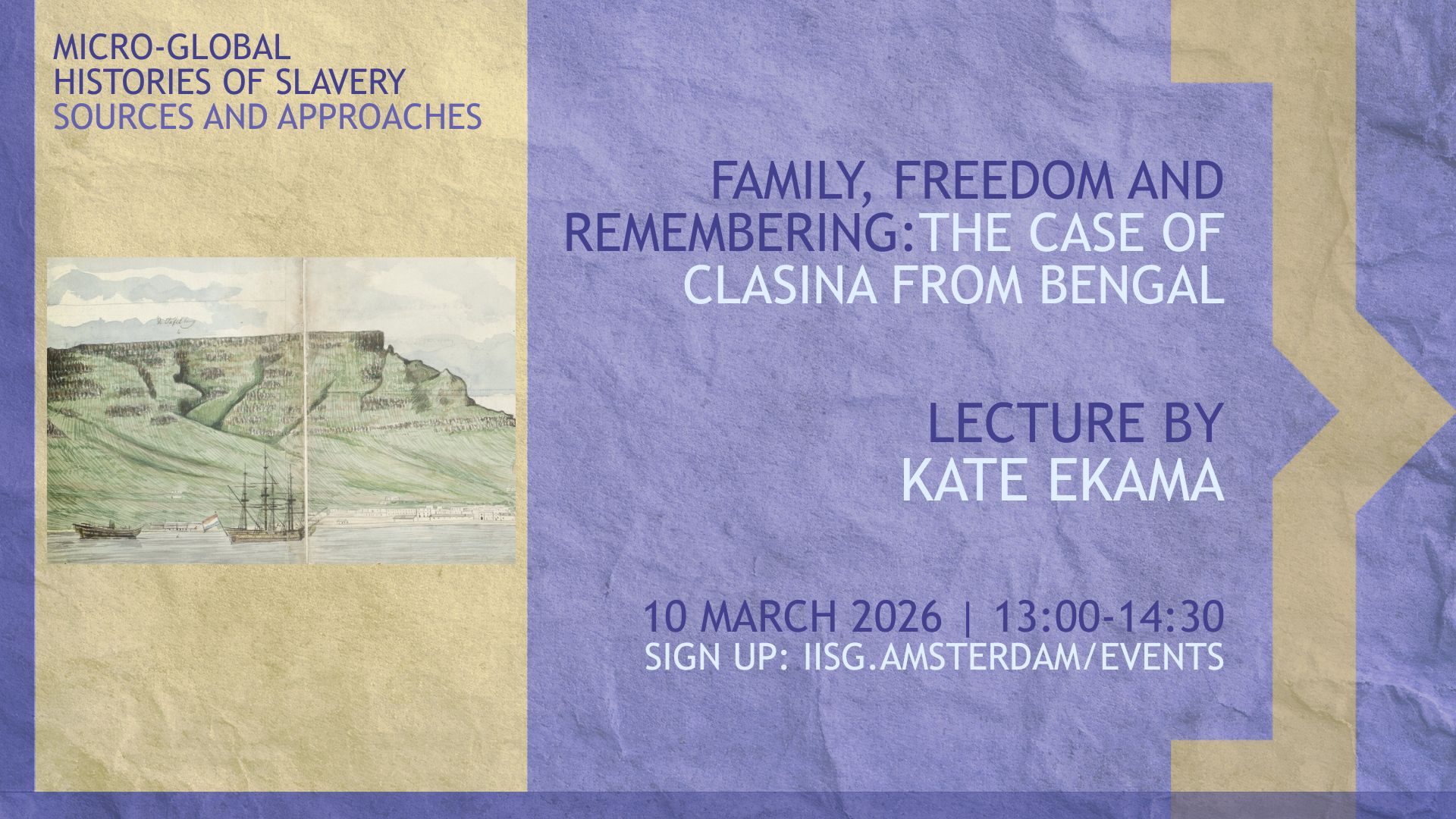
We warmly invite you to join the next gathering of the monthly seminar series Micro-Global Histories of Slavery: Sources and Approaches with Kate Ekama who will give a talk titled Family, freedom and remembering: The case of Clasina from Bengal.
In 1811, a woman recorded as Clasina of Bengal submitted a petition to the then Governor of the Cape Colony, the 2nd Earl of Caledon, in which she requested an inquiry into the reasons why she, her children, and grandchildren were held in slavery. In her petition, she remembered arriving at the Cape as a free child in the 1740s, in the company of her parents. Over the following years she and her descendants were enslaved. Clasina's request was granted: The investigation was conducted and reported on to the Court of Justice between February 1811 and January 1812. The conclusion of the matter was that Clasina, her daughters, and their children, were rightfully enslaved. Their case was picked up again in 1814 when Cape Governor Sir John Cradock forwarded the details of Clasina’s case to Lord Bathurst in London, and so it took on a new significance in questions of law and freedom in the British Cape Colony. In his letter Cradock wrote “I am persuaded, and so is the Public, that she is not a slave; but the difficulty lies in the obligation to prove it.” Clasina’s case opens a window onto three intersecting issues: freedom claims, proving legal status, and recording family ties. This lecture examines the evidence collected in the investigation, reflects on the use and creation of archives, and multilayered memories of enslavement.
Practical information
Date 10 March 2026
Time 13:00-14:30
Place IISG, Cruquiusweg 31, Amsterdam
Admission Free, but please send email to Sanne Muurling (sanne.muurling@ru.nl) due to the organisation.
Online participation via Zoom is also possible. Let us know in your registration email if you would like to receive the Zoom link.
More information You can find more information on upcoming seminars at the events page on voices.iisg.nl.
Kate Ekama is a postdoctoral fellow in the Department of Economics at Stellenbosch University. She researches slavery and emancipations in the Indian Ocean World. Her work addresses aspects of the lived experience of slavery, how the practice was regulated, and the financial underpinnings of slavery and emancipation in the eighteenth and nineteenth centuries. She is affiliated to LEAP Stellenbosch, the Biography of an Uncharted People project and The Cape of Good Hope Panel.
About the Seminar Series Micro-Global Histories of Slavery: Sources and Approaches
A global turn in slavery studies urges us to bring together the study of histories of slavery from across the globe, from Asia to the Atlantic, from local regimes of slavery to the impact of colonial slave trade and slavery.
Linked to the combined research team of slavery projects at the International Institute of Social History (Amsterdam) and Radboud University (Nijmegen), this seminar aims to further critical reflections of sources and approaches for the study micro-global histories of slavery. We invite scholars to share insights, questions and ideas that are grounded in research practice and experiences with colonial and other or vernacular sources. Discussing sources, research practices and methodologies thus serves as a way to further develop the practice of micro-global histories of slavery.
The seminar series is organized by a coalition of research and data projects at the IISG and the RU
Voices of Resistance: A Global Micro-Historical Approach to Enslavement across the Atlantic and Indian Ocean
Resisting Enslavement: A Global Historical Approach to Slavery in the Dutch Atlantic and Asian Empire (1620-1815)
The Global Business of Slave Trade: Patterns, Actors and Gains in the Early Modern Dutch and Iberian Slave Trade
Exploring Slave Trade in Asia