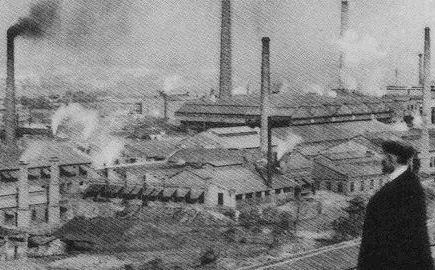
The Historical Dynamics of Industrialization in North-Western Europe and China, 1800-2010
- Project lead: Bas van Leeuwen
- Project start: 2015
- Project end: 2021 (informally ongoing)
- Grant: circa € 1,400,000 by European Research Council | ERC Starting Grant
This project is based on an ERC Starting Grant of circa 1.4 million euros, awarded by the European Research Council (ERC) to Dr Bas van Leeuwen. This 5-year lasting research project is entitled ‘The Historical Dynamics of Industrialization in North-Western Europe and China, 1800-2010.’
The project aims to study which factors determine how, at what pace, and the manner in which industries developed in the different European and Chinese regions. The underlying question is whether the Industrial Revolution in Northwest Europe has indeed been decisive for the way in which other regions of the world developed.
The project not only examines regional development, but also the effects of the pace at which the industrialization process occurs. One example consists of the so-called Great Divergence debate (18th-19th century) in which the central question is how it is that prosperity in Europe from the end of the eighteenth century grew much faster than in China. For today's developing economies, these are practical questions they have to deal with. Expectations are that the results of this study will also help us understand the current spectacular economic growth in China (and the stagnation in Europe) and its impact on global patterns of social inequality.
Even though this project ended informally in 2021, it continues informally up to today. This present-day cooperation is mainly driven by continuing the work on the topic of industry and growth, including starting new projects on the topic of industrialization. The focus of this research has been on three factors:
- Regional data are important for analyzing the growth and spread of industrialization. For that reason, an important focus of the research has been on the construction of data sets. One example is extending the books series the Quantitative Economic History of China . In addition, other regional data, like the National Register of 1939 for England, are made available. Some of the permanently stored data can be found in Dataverse
- The choice between micro and macro analysis also affects how production factors relate to industrialization. See, for example, Bas van Leeuwen, Robin Philips, Erik Buyst (eds.). An Economic History of Regional Industrialization. Oxon and New York, Routledge
- Comparisons are quite important for identifying the driving forces of industrialisation. For example, micro interactions in technology and production transfer, e.g. European businessmen traveling to China to set up factories. What was their motive? What about technology transfers? Likewise macro comparisons on a country or continental level, can provide much evidence of industrial growth and change. See, for example, Leeuwen, B. V., Didenko, D., Calabrese, M., & Wang, M. (2025). Innovation and Economic Development in Eurasia, 500 BCE-Present: The Roots of Divergence. (Frontiers in Economic History). Springer Nature.