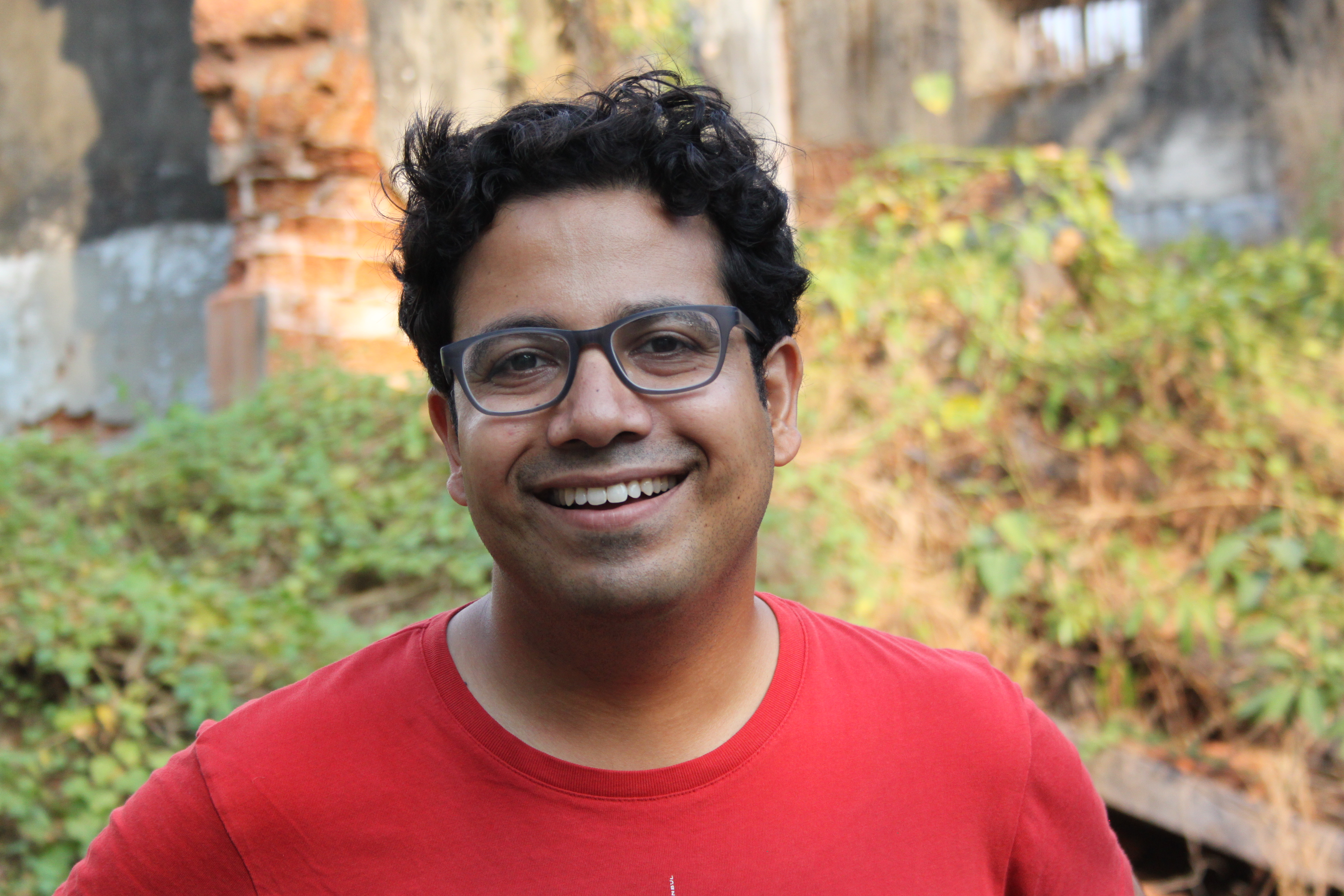
Kushanava Choudhury
Kushanava Choudhury is a writer, journalist and political theorist. He has a PhD in Political Theory from Yale University and has been a Senior Fellow at the University of Pennsylvania and a Ferris Professor of Journalism at Princeton University.
Kushanava has worked as a journalist for more than twenty years and written for the New York Times, The Wall Street Journal and other publications. After graduating from Princeton University, he moved to India to work as a newspaper reporter in Calcutta at the city's largest English daily. His experiences were the basis of his first book, The Epic City: The World on the Streets of Calcutta (Bloomsbury 2018). From 2015-2021, he was based in India and wrote for The Caravan, India's leading magazine for investigative journalism and narrative nonfiction.
His forthcoming book, The Big Love (Bloomsbury, 2026) is set during the Covid-19 Pandemic and draws on four years of reporting and oral testimonies from New Delhi, Kerala and Bengal to understand how societies produce manmade catastrophes and how people become free.
He has also translated a collection of oral testimonies of witnesses of the Bengal Famine of 1943, a largely-forgotten manmade crisis during the Second World War when the British ruled India. The Famine Album will be published in 2026 and tells the stories of the estimated three million people -- one in 20 Bengalis -- who lost their lives due to hunger.
As a Global Slavery History Fellow at IISH, he traced the history of the "Van Bengalens", who were people enslaved or trafficked from Bengal, as part of the slave trade from the 16th through 18th centuries. His research follows the Van Bengalens across the Indian, Atlantic and Pacific Oceans, to Indonesia, South Africa, the Netherlands and even Mexico and Peru. Their stories reveal a global network of forced labor which arose along with the corporation, the stock exchange, modern banking and capitalism.
His research builds on emerging scholarship at IISH which opens the aperture of slavery studies beyond the North Atlantic, to include the slave trade in the Americas, Asia and the Pacific. Tracing the global history of capitalism and forced labor reveals how ideologies of racial difference between human beings, based on skin tone, hair texture and other other superficial factors, were used to justify a colonial order built on structural inequalities which still exists today. His research at IISH will be part of a new book on global slavery, titled The Hidden History of the Color Line.