Global Labour Relations

EMPIRELAB: Subaltern Workers, Labour Relations and Empire Building in the Portuguese Estado da Índia (1510-1663)

3 March 2026 14:13

How and to what extent did mostly unfree Asian and African labour contributed to build and sustain the Portuguese Asian empire during the 16th and 17th centuries? This is the main question addressed by EMPIRELAB.  The project explores case study of the Estado da Índia, the Portuguese early modern empire in Asia, between 1510 and 1663. It aims to understand whether this early modern empire was able to develop and sustain itself (even in times of decline) due to a highly intensive extraction and allocation of non-European labour, especially when compared with other European counterparts in the Indian Ocean, namely the Dutch and the English. 
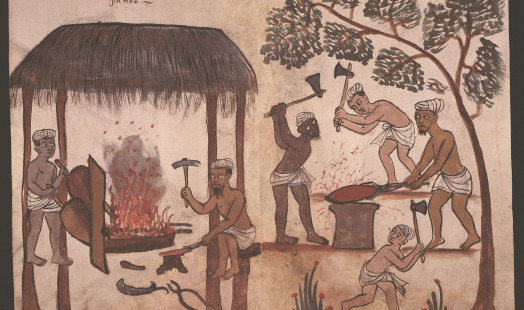
Anonymous 16th century Portuguese illustration from the Códice Casanatense, depicting blacksmiths from Goa, in the Kanara Coast. The inscription reads: "Kanarese blacksmiths from Goa. Gentiles

TASTADE (The Trans-Atlantic Slave Trade and the Development of Europe)

18 November 2025 14:56

ERC Synergy project to investigate the role of the slave trade in the development of Europe

Zaan Region, Slavery, and Colonial History

19 June 2025 14:11

The Zaan region can be regarded as the cradle of Dutch industry. Beginning in the seventeenth century, this area became the center of Dutch shipbuilding and various other manufacturing sectors. 

Global Slavery History Fellowships

A coalition of Amsterdam based Archives, Museums and Historical institutes* with the generous support of the Insinger Foundation has taken the initiative for a five-year programme that offers two-month long fellowships per year for curators, archivists and historians in the field of slavery history, starting in the Fall of 2024. 

Slaves, commodities and logistics

27 November 2023 15:27

How important was Atlantic slavery for the Dutch economy in the eighteenth century?

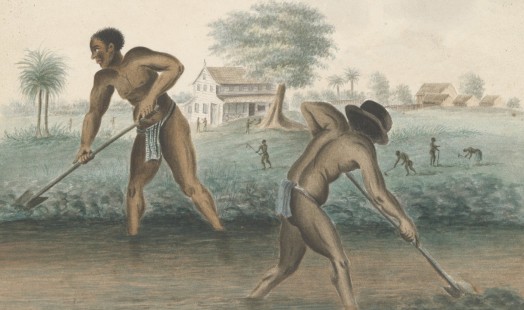
Drawing: Enslaved men working in the fields, anonymous, c. 1850

The Global Business of Slave Trade: Patterns, Actors and Gains in the Early Modern Dutch and Iberian Slave Trade

9 November 2023 16:22

The research will center around three main regions that are pivotal to improving our understanding of slavery and slave trade east of the Cape of Good Hope, namely the trade from and to South and Eastern Africa, the South China Sea, and the Indonesian archipelago.

Slavery Insured

7 November 2023 12:50

The project “Slavery Insured: A study into the Amsterdam Assurantie Compagnie 1771 and its involvement in slavery, 1771-1873” focuses on the history of one Amsterdam insurance company and its involvement in slavery. So far, the role of insurance companies in both the slave trade and the trade in slave-produced commodities has remained under-researched.

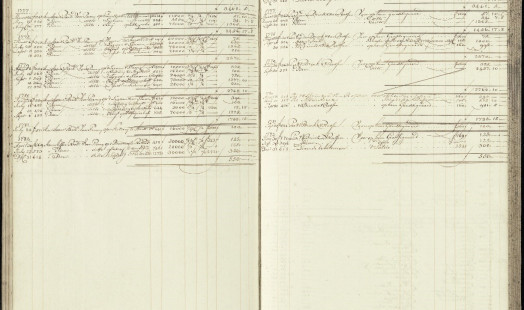
An 1771 Amsterdam Assurantie Compagnie ledger page showing Dutch merchant Nicolaas Jan van Baggen's insurance policy on the lives of enslaved people

Exploring Slave Trade in Asia

14 May 2019 13:52

Exploring Slave Trade in Asia - Towards an Indian Ocean and Maritime Asia Slave Trade Database

Database


This project builds a database that reconstructs the historic slave trade in the Indian Ocean and Maritime Asia region in collaboration with an emerging network of scholars committed to develop a coherent field of Asian slave trade and slavery studies, including East, Southeast and South Asia as well as South and East Africa.

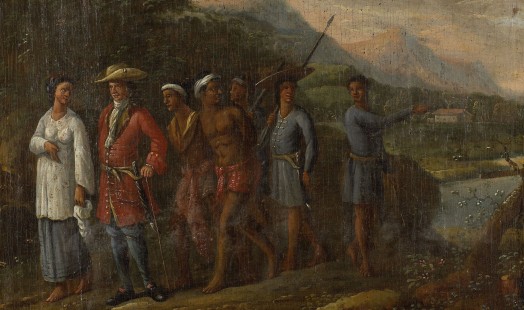
Hollandse koopman met slaven in heuvellandschap, anoniem, 1700 - 1725

Global Collaboratory on the History of Labour Relations, 1500-2000

4 April 2019 11:45
  • Project-leader: Karin Hofmeester
  • Start: 2013
  • Grant: € 218,500 by Gerda Henkel Stiftung
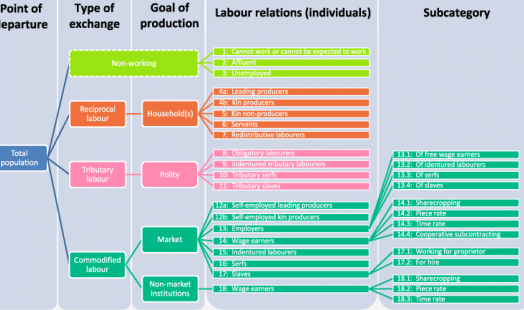
nfographic titled 'Taxonomy of Labour Relations' by the Global Collaboratory on the History of Labour Relations. It shows a hierarchical classification system branching from the total population into 'Type of exchange', 'Goal of production', 'Labour relations (individuals)', and specific 'Subcategories'. The primary categories of labour identified are Non-working, Reciprocal, Tributary, and Commodified.