Global Collaboratory on the History of Labour Relations, 1500-2000

04 April 2019 - 11:45
  • Project-leader: Karin Hofmeester
  • Start: 2013
  • Grant: € 218,500 by Gerda Henkel Stiftung

The International Institute of Social History is working on a Global Collaboratory on the History of Labour Relations in the period 1500-2000. 

The Global Collaboratory on the History of Labour Relations is a collaborative effort to study labour relations in a global perspective. The project has two main goals. First, to provide statistical insights into the global distribution of all types of labour relations (systematically including women's and child labour) in five historical cross-sections: 1500, 1650, 1800, 1900, [Africa: 1950], and 2000. Second, to explain the signalled shifts in labour relations worldwide.

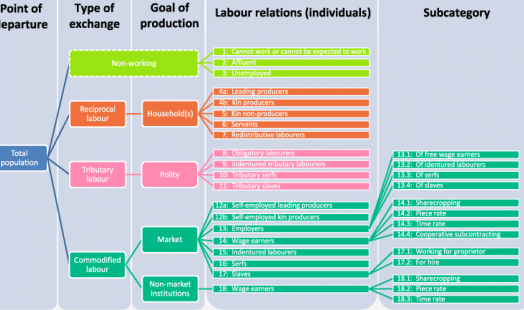
nfographic titled 'Taxonomy of Labour Relations' by the Global Collaboratory on the History of Labour Relations. It shows a hierarchical classification system branching from the total population into 'Type of exchange', 'Goal of production', 'Labour relations (individuals)', and specific 'Subcategories'. The primary categories of labour identified are Non-working, Reciprocal, Tributary, and Commodified.

Data Website

History of Labour Relations 1500-2000

Data Website
nfographic titled 'Taxonomy of Labour Relations' by the Global Collaboratory on the History of Labour Relations. It shows a hierarchical classification system branching from the total population into 'Type of exchange', 'Goal of production', 'Labour relations (individuals)', and specific 'Subcategories'. The primary categories of labour identified are Non-working, Reciprocal, Tributary, and Commodified.

Project leader

Karin Hofmeester
Karin Hofmeester