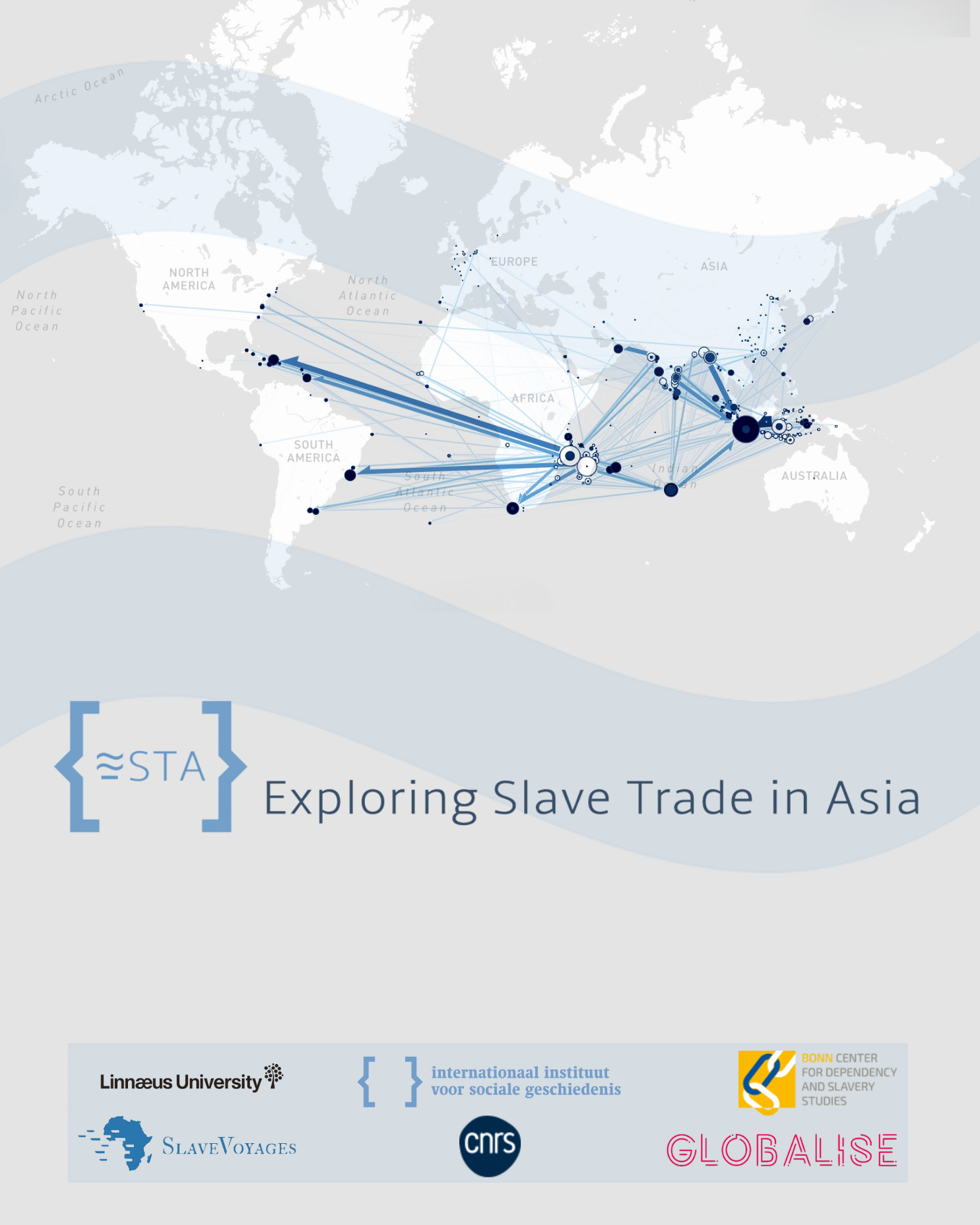
New launch Exploring Slave Trade in Asia (ESTA) Database
The Exploring Slave Trade in Asia (ESTA) project at the International Institute of Social History (IISH) in Amsterdam proudly announces:
- The second version of the ESTA Database, now containing about 5,300 voyages that refer to at least 440,000 enslaved individuals who were forcibly transported across the wider Indian Ocean World. Six new datasets have been added, focusing on China, the Mascarenes, Mozambique, and East India.
- TIDES, a new data-entry system for teams and individuals. It enables trusted researchers and students to share their data with the project by entering and curating data for inclusion in the ESTA Database. Contributors receive full credit for their data.
What is the ESTA Database?
For those who do not know us yet: the ESTA Database is a collaborative initiative involving scholars from around the world to collect information on slave-trade voyages and enslaved individuals in the Indian Ocean, the Indonesian Archipelago, and the East Asian Seas. The project began in 2016, and the first public dataset and map viewer on the slave trade in Asia was launched by ESTA in 2023.
Our Core Mission
The ESTA team creates, collects, curates, and shares data to understand the various manifestations of slave trade and other forms of enslavement and coercion. We consider it essential to record all these forms of slave trade in as much detail as possible. The database paves the way for more accurate reconstructions of the scale, structure and patterns of the slave trade.
From the beginning, the ESTA Database has been developed in close collaboration with individual scholars and institutions including the International Institute of Social History, Linnaeus University, the Bonn Center for Dependency and Slavery Studies, the Centre national de la recherche scientifique, Slave Voyages, and Globalise.
Open and explicit crediting of contributing scholars and partners holds a central place in our way of working. We welcome everyone to use the ESTA database and viewer, and we hope to receive same courtesy by crediting the project when using our data.
TIDES
TIDES (Team/Individual Data Entry System) is a new system that allows contributors to generate an independent dataset based on their shared data, deposit it in the IISH Dataverse, and receive a DOI as a full publication. Users remain in full control of their own entries.
Present and future
In the years ahead, we will continue improving the data collections available on slave trade in the wider Indian Ocean, the Indonesian Archipelago, and the East Asian Worlds, as well as their connections to the Atlantic and to slave trade in mainland Asia. These underexplored global histories of slavery and slave trade, and the understanding of how different regimes of enslavement shaped societies and people’s lives, are simply too important to remain overlooked.
Over the past two years, we have continued working on these massive challenges together with partners in digital humanities infrastructure for VOC archives, the China Human Trafficking and Slaving Database, and the expanding cluster of slavery-related projects at the International Institute of Social History.
New data on slave trade from seventeenth- and eighteenth-century Southeast India, Myanmar, the Indonesian Archipelago, South Africa, and other regions has been collected and is currently being curated. This material will soon be made available online.