Toxic Work Environment? Poisonous Elements in the Travelogues Collection
The International Institute of Social History (IISG) holds a remarkable collection of travelogues dating from the 16th to the 19th century. These travel stories document European journeys to all corners of the world. The collection belongs to the library of the Royal Netherlands Academy of Arts and Sciences (KNAW) and is managed by the IISG (part of the KNAW) since 2005.
The majority of these travelogues describe scientific explorations. However, a considerable amount also contain detailed narratives of colonial encounters. As such, the collection connects closely to several of the Institute’s current research projects, including those within the Global Labour Relations cluster, such as The Global Business of Slave Trade and Exploring Slave Trade in Asia (ESTA).
These travelogues recount stories of colonial expansion and exploration, while reinforcing a colonial perspective. At the same time, their preservation and accessibility allow us to critically examine and confront the actions and attitudes of colonial actors.By studying these travel stories, we can reflect on how historical language and mindsets relate to present-day discussions about colonialism and its legacy.
What can we learn from these travel narratives? What insights can we gain when we read them from the perspective of the colonized people rather than the colonizer? How does our relationship with coloniality shape the way we analyse these texts? We should approach them as a an opportunity to humanize the people whose lives were captured through the lens of a colonial writer.
Interest in the collection has recently been revived. The Collections Department has been updating the metadata and catalogue descriptions, while a research initiative - The Travelogues Project - was carried out by several students as an internship. I worked on this project alongside interns Yara Abu Khadijeh and Nina van Daalen, as well as student assistant Marina Goutet. The project aimed to improve the accessibility and discoverability of the travelogues, in order to stimulate research on this collection. This was done by enriching their metadata and compiling a list of reliable digital copies of the travelogues. While the work was challenging, I was initially not aware that working with the physical books themselves might involve unexpected risks.
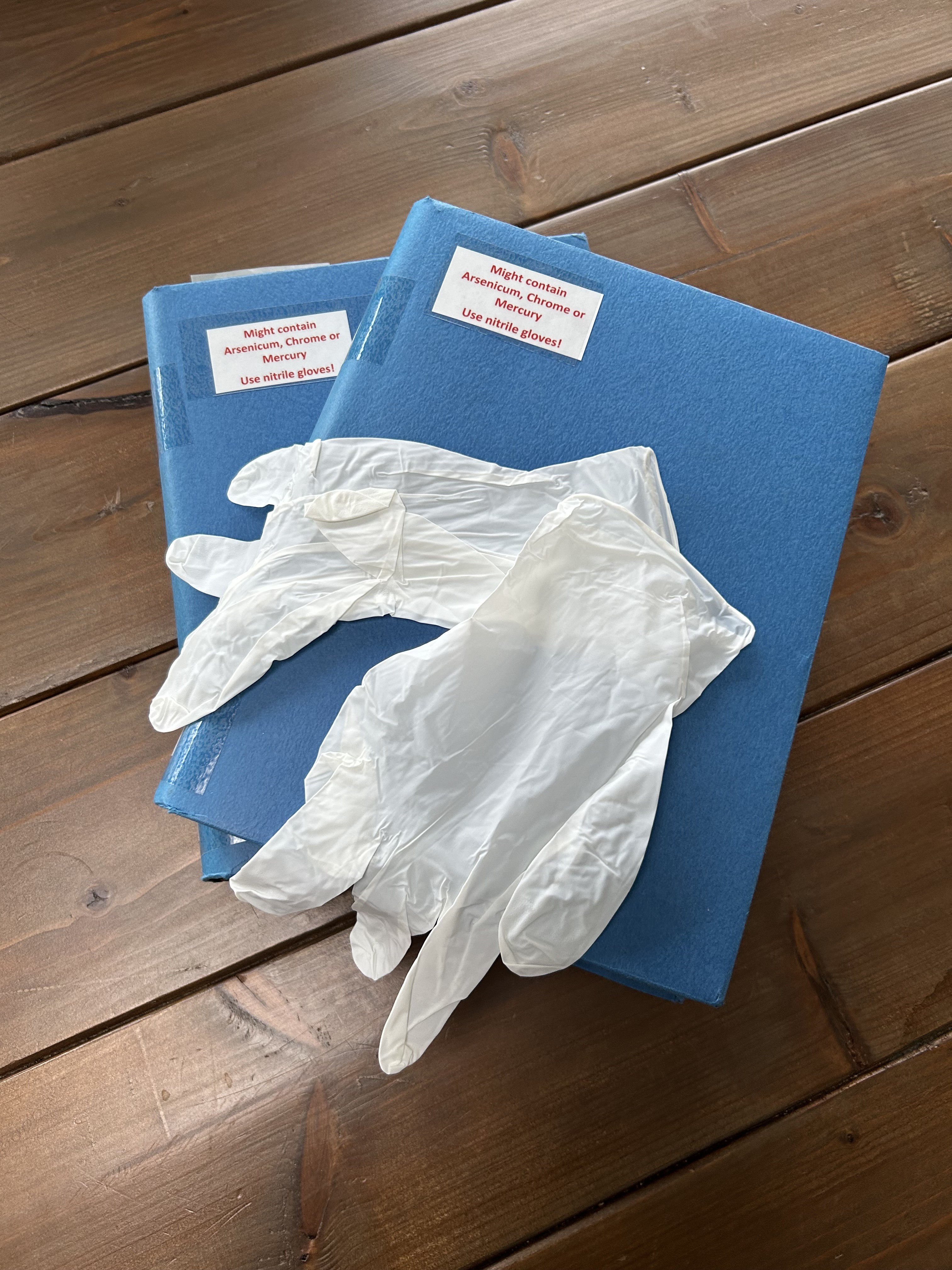
Books published in the early modern period can be very dangerous due to heavy metals infused in their covers and pages. Heavy metals such as arsenic, mercury, chrome, and lead were commonly used to create pigments. Colours like green, yellow, and vermillion were often created using these toxic substances. The pursuit of visually aesthetically books has long been an important aspect of publishing, but exposure to such metals can cause health problems.
Fortunately, the Reading Room staff were transparent about these risks when we consulted the physical travelogues. Books suspected of containing hazardous materials were clearly labelled, covered, or withheld from consultation. We were advised to wear gloves, avoid touching our faces, and wash our hands after each consultation session. The presence of potentially toxic elements was also noted in our dataset. For researchers concerned about handling the physical materials, the availability of accurate digital versions of the travelogues we found online minimizes the need for direct contact.
All in all, despite the “toxic” work environment, I enjoyed my time working with the travelogue collection. I hope that interest in these materials continues.
By Myka Angela Mekell