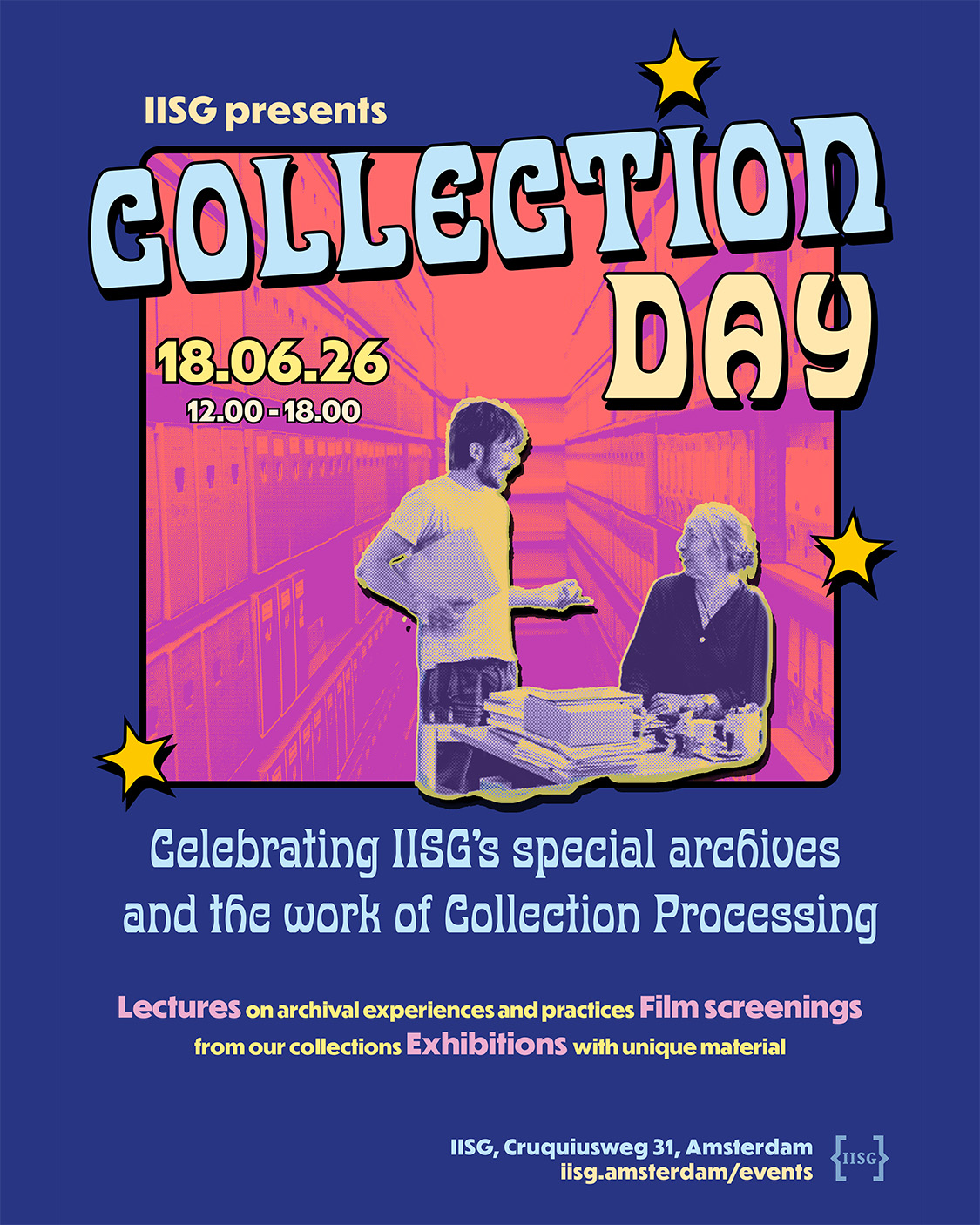
IISG Collection Day 2026
The IISG Collection Day focuses on the work of our Collection processors. Our colleagues, ranging from archivists and collection conservation and preservation staff to collection documentation specialists, will discuss the unique collections that pass through their hands every day, as well as the broader issues and emotions these collections evoke.
How do we collaborate with archive creators? How are conservation and digitisation applied to medieval materials? What are the possibilities and limitations of AI in archival work? How do you deal with the emotional burden of archives describing atrocities? What should you do if the standards and guidelines that archivists must follow do not align with your personal vision and values?
These and other topics will be discussed at the IISG Collection Day. This event is being organised to mark the conclusion of the KNAW Bypass Project, an experimental initiative that gives users access to digital born archives.
The celebratory programme includes:
- Lectures and discussions on experiences and practices in the field of archiving
- Film screenings from the IISG collection
- Exhibitions featuring special collection items
- A festive end of the day with drinks and music
Programme
Schedule
| Time | Session | Speaker(s) |
|---|---|---|
| 11:30–12:00 | Walk-in | |
| 12:00–12:15 | Welcome & Opening | |
| 12:00–16:30 | Happy Summer, Amsterdam! (film screening on a loop) | |
| 12:15–12:35 | Collection Processing and Conservation: Medieval and Modern Materials | Jelle Verdijk and Daniel van Heusden |
| 12:40–13:00 | Affective Connection, Empathic Strain: Processing Wim Go Gien Tjwan Archives | Rika Theo |
| 13:00–13:30 |
| |
| 13:30–13:50 | Guerra al fascismo and the Cineclub Vrijheidsfilms Collection: Challenges of an Unknown Film Archive | Fidel Duran |
| 13:55–14:15 | The Bypass Project: Developing an Experimental Infrastructure for Born Digital Archives | Alaina Rose |
| 14:15–14:45 |
| |
| 14:45–15:05 | Archivists Between the Hammer and the Anvil | Hawra Nissi |
| 15:10–15:30 | Archival Work and the Ethics of Automation | Julia van der Knaap |
| 15:30–16:30 |
| |
| 16:30–18:00 | Live Music & Drinks |
Presentations
Collection Processing and Conservation: Medieval and Modern Materials
Jelle Verdijk and Daniel van Heusden
Examining the history of two special archival collections: the Komitee Wetenschap en Techniek voor Vietnam, Laos en Cambodja archive and the Velle Collection, Jelle Verdijk and Daniel van Heusden highlights unique items from each collections, reflects on the experience of working alongside archival creators and the ways in which these relationships shape professional practice, and discusses the conservation and digitization approaches applied to medieval materials.
Affective Connection, Empathic Strain: Processing Wim Go Gien Tjwan Archives
Rika Theo
The archives of Chinese-Indonesian scholar activist and political exile, Wim Go Gien Tjwan, is one among many archives containing atrocities, injustices, human suffering, and survival that are under the custody of the IISG. Processing these archives, which are "not only the storehouse of memory and fact, but also a repository of trauma and pain…where unpacified ghosts with unfinished business await" (Murphy 2011, p.481), brings a purpose of archival activation to support truth telling, justice, healing, and reconciliation. However, it also has emotional impacts on the archivists working with these records as they witness the landscape of pain, in the text and in the context, continuously. The emotional impact intensifies and is more inevitable for the archivists who are part of that suffering, as archivists, just like community users and historians, bring in themselves their history and experiences when encountering the archives. In this presentation, Rika Theo will share the emotional labour and archival-inflicted trauma throughout the daily processing routines of these archives, to open up a dialogue for a trauma-informed practices and responsibilities at the IISG.
Guerra al fascismo and the Cineclub Vrijheidsfilms collection: Challenges of an Unknown Film Archive
Fidel Duran
The Cineclub Vrijheidsfilms' film production collection is one biggest and yet unknown audiovisual collections preserved at the IISG. With more than 800 cannisters of unfinished productions, raw material and unique footage of social fights, filmed between the 1960s and 1980s, the digitization of the analogue material in this collection presents significant challenges. How to appraise material that is unidentified? How to contextualize the material, once digitized? What possible strategies for the presentation or restoration of this material are there? Focusing on the unfinished film Guerra al fascismo, produced in collaboration with the Spanish anti-Francoist group FRAP, Fidel Duran examens at the inspection workflow of analogue film material and discuss challenges and possibilities when working with audiovisual collections.
The Bypass Project: Developing an Experimental Infrastructure for Born Digital Archives
Alaina Rose
The Bypass Project was an experimental initiative designed to tackle the digital backlog at the IISG. Rather than following traditional archival processing workflows, the project explored whether responsible access could be provided to unprocessed, digital born archives. In collaboration with software developers, archivists, and historical researchers, search interfaces were developed and made accessible through a secure virtual desktop environment (KASM), allowing researchers to access a selection of these special collections for the first time.
Archivists Between the Hammer and the Anvil
Hawra Nissi
When it comes to daily decisions, Hawra Nissi often feels like she's stuck between the hammer and the anvil. Archivists, like all employees, must follow standards, regulations and guidelines. But what if these do not align with the archivists’ vision and values? How do we strike a balance between the two if they clash? How can we maintain objectivity in the face of the archive’s ongoing influence on archivists, and vice versa? Should triggers and traumas be shoved to the side during archival work, or should they be used as an opportunity for keeping the spirit of the archive? These are a handful of the question that surfaced when she was processing the archive of the Committee of the Moroccan Workers in the Netherlands (KMAN). She will discuss her experiences based on these questions.
Archival Work and the Ethics of Automation
Julia van der Knaap
Julia van der Knaap explores several ethical issues that arise from the use of generative AI technologies (primarily Large Language Models), with a focus on archival work. It will address how these models work and the fundamental issues that leads to, such as bias and inaccuracies, and why this is particularly important when thinking about using these models for archival description. The session connects to the other talks by drawing on their stories of human archival work and the importance of the interaction between archive and archivist to show that automating this work comes at a significant cost.
Exhibitions and films
Not only will there be presentations, but special material from our collection will also be on display. This includes material we have been working on over the past year. Examples include books from the library of the Royal Netherlands Academy of Arts and Sciences, old maps, items from the Hong Kong Protest Movement collection (2019–2020), and photographs by various photographers. Films from our collection will also be screened.
Practical information
Date: 18 June 2026
Time: 12:00-18:00
Venue: IISG, Cruquiusweg 31, Amsterdam
Admission: Free admission, but registering via event@iisg.nl is mandatory.
Language: English