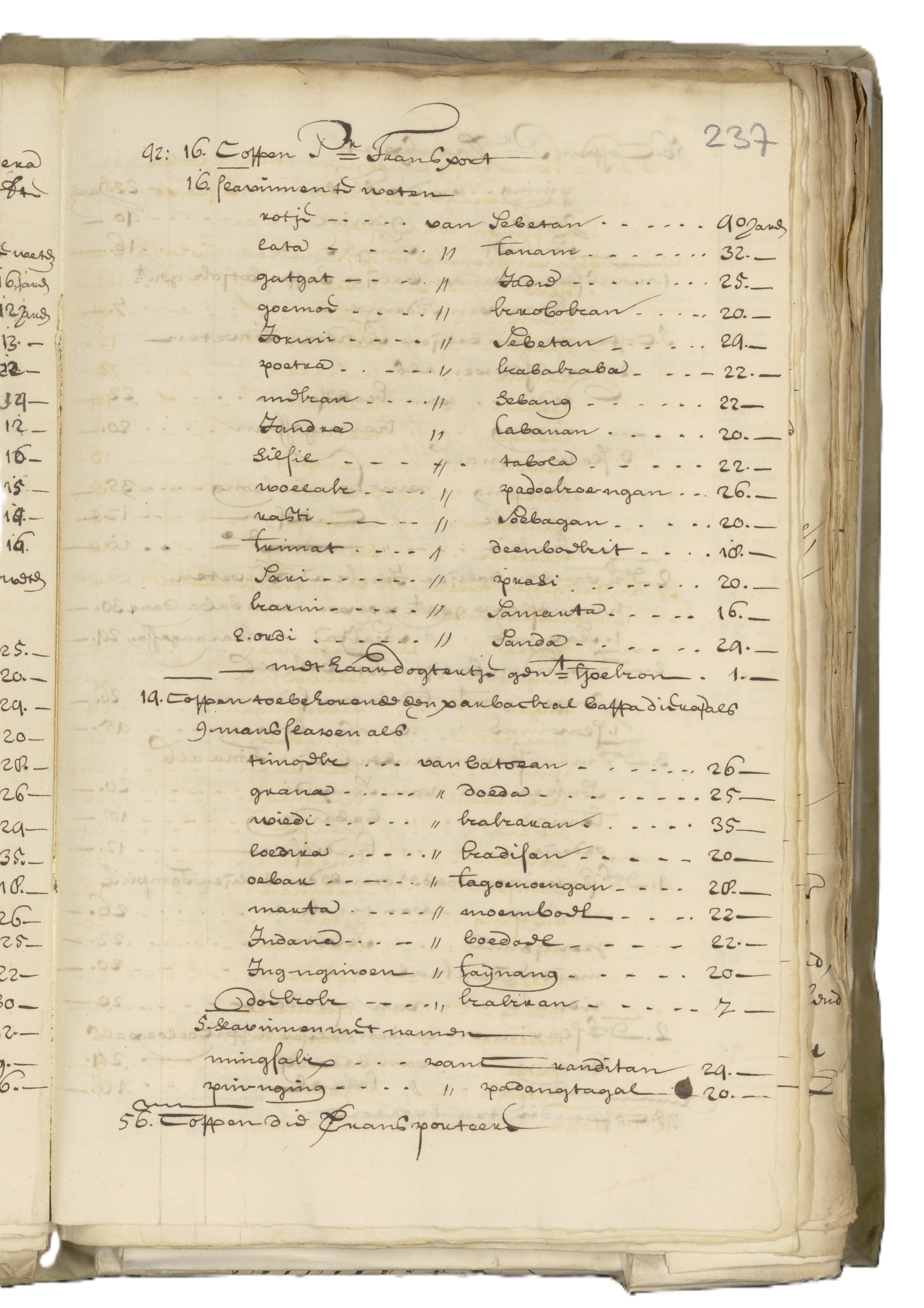
Chains of the Past enables the reconstruction of the lives of enslaved people
In the new project Chains of the Past: Open Infrastructure for the Global History of Dutch Slavery and Slave Trade, the Institute of Social History (IISG), Radboud University and the KITLV are collaborating with a large number of genealogical and heritage organisations to start building an online infrastructure that will make archives on the history of Dutch Atlantic and Asian slavery searchable.
This is achieved by identifying and linking information about the lives of enslaved people from colonial archives. This includes, for example, their names and ages, which can be found in slave registers, government journals, and VOC archives.
Chains of the Past is a collaboration between two of the largest slavery data projects in the Netherlands: the Exploring Slave Trade in Asia (ESTA) project at the IISG and the Historical Database Suriname and the Caribbean (HDSC) at Radboud University's Radboud Institute for Culture and History. The project's goal is to create an open science infrastructure that connects archives through digitisation and entity recognition, among other things, making it possible to track individuals across different archives.
Project coordinator Matthias Rosenbaum-Feldbrügge: 'This broad and inclusive collaboration enables us to find and follow enslaved people in highly fragmented archival material, which is an important step for the field and communities alike.'
This creates a truly connected digital heritage that is available for scientific and ancestral research by genealogists and descendant communities. The project is not only for the communities, but also by them: an important part of Chains of the Past is citizen science, in which communities collaborate to connect archives. This makes the infrastructure an international showcase for inclusive open science.
ESTA coordinator Pascal Konings: 'Chains of the Past provides an impetus not only for reconstructing the underexposed slave trade in Asia, but also for bringing to light the personal histories of slavery that are crucial to understanding the impact that this trade had on people's lives worldwide.'
Chains of the Past has been made possible by an Open Science Infrastructure Grant from Open Science NL and will run for three years. The applicants are Matthias Rosenbaum-Feldbrügge and Coen van Galen (Radboud University), Matthias van Rossum, Richard Zijdeman, Rick Mourits, and Filipa Ribeiro da Silva (IISG), and Esther Captain (KITLV). Matthias Rosenbaum-Feldbrügge will coordinate the project.