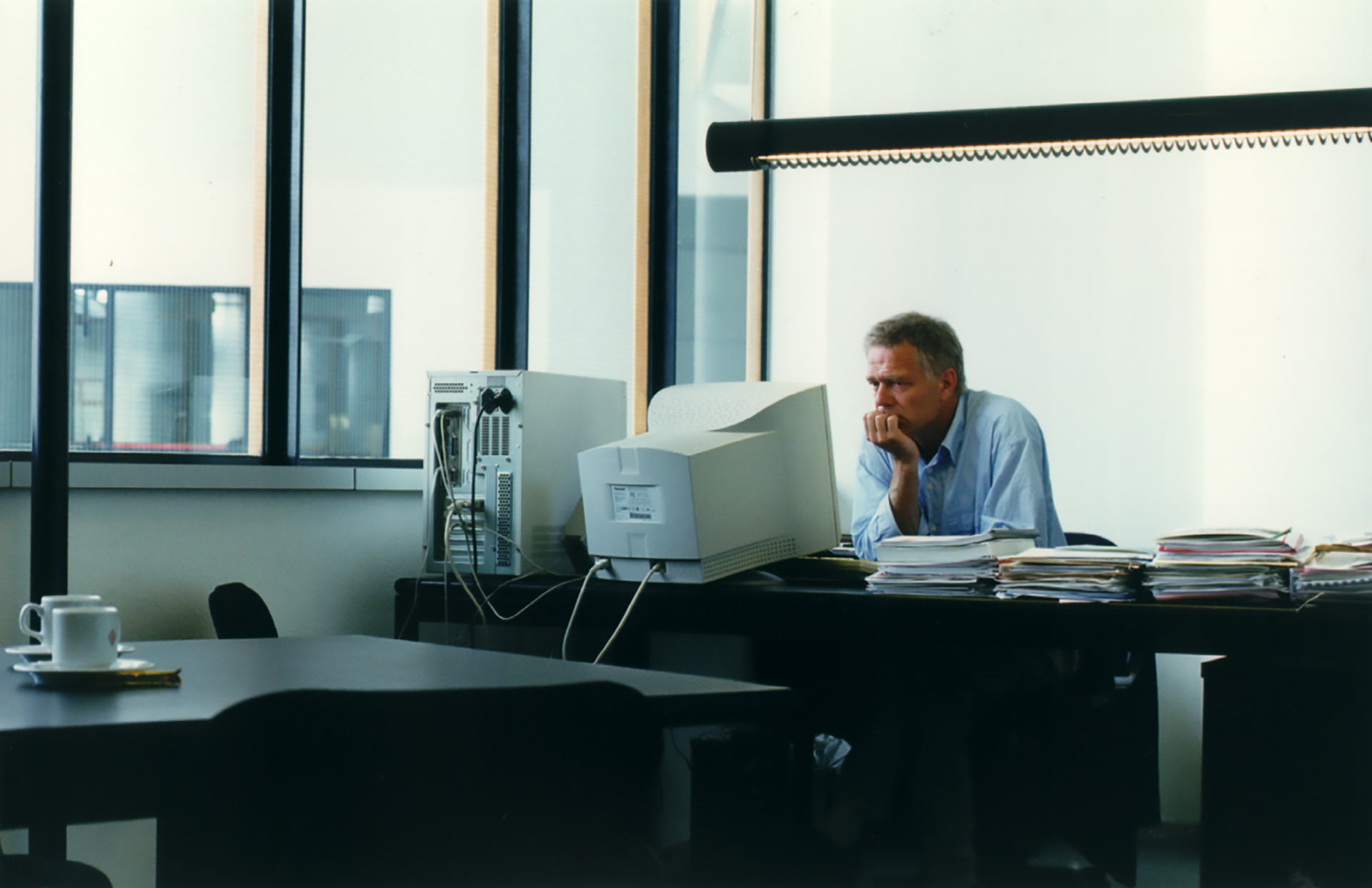
In Memoriam: Jaap Kloosterman (1948-2026)
Jaap Kloosterman spent most of his working life at the International Institute of Social History (IISH) in Amsterdam, serving as a researcher, librarian, and board member before becoming director from 1993 to 2008 – the longest tenure since the institute’s founder, Nicolaas Posthumus. Jaap Kloosterman was a guardian of collections and a friend to collectors. He remained involved with the IISH until the very end.
From an early age, Jaap Kloosterman was a voracious reader who made a point of reading works in their original languages. His appetite ranged widely: the literature that fed his radical anarchist convictions sat alongside classical philosophy and the French intellectual tradition.
He joined the IISH in 1969 as an assistant to Arthur Lehning (1899 - 2000) who was editing the complete works of Bakunin – the Archives Bakounine project eventually comprising seven volumes. Jaap’s contribution was soon formally acknowledged: from 1978 he was credited as assistant editor, and from 1980 onwards as editor on equal footing with Lehning.
When the IISH was placed under the aegis of the Royal Netherlands Academy of Arts and Sciences (KNAW) in 1979, its collections remained the property of the independent IISH Foundation. Jaap was among the first to grasp the transformative potential of automation, digitisation, and the internet for widening access to the collections, strengthening international cooperation, and developing new resources for research.
This vision and experience led to his appointment as deputy director and head of collections in 1987, and to the directorship in 1993. Throughout he advocated pragmatic cataloguing as the key to making collections genuinely usable. It was the use that mattered, not curatorial reverence. His efforts have enabled the IISH to expand its global reach to China, Southeast and Southwest Asia.
Furthermore, his deep commitment to Russian collections and institutions, among them the former Marx-Engels Institute and Memorial, demonstrates his open-mindedness and generosity. During the first period as (deputy) director, he also ran the secretariat of the International Association of Labour History Institutions (IALHI), broadening its membership well beyond Europe and the United States to include institutions across the Global South.
Those who knew Jaap Kloosterman will remember his kindness, his intellectual depth, and his modesty – qualities audible in his quiet voice and his preference for understatement.